Complete Guide to Desiccants for Pharmaceutical Packaging: FDA & USP Compliant Moisture Control Solutions
Desiccants for Pharmaceutical Packaging Moisture is one of the most underestimated threats in pharmaceutical packaging. Even minimal exposure to humidity can compromise drug stability, reduce shelf life, degrade active ingredients, and ultimately impact patient safety. For pharmaceutical manufacturers, nutraceutical brands, and contract packagers, moisture control is not optional — it is critical.
Selecting the right desiccant solution is not simply about absorbing humidity. It involves regulatory compliance, adsorption performance, material compatibility, temperature stability, packaging design, and export standards.
This guide explains everything pharmaceutical companies need to know about desiccants — including silica gel, molecular sieve, activated carbon, and custom blends — and how to choose an FDA and USP compliant desiccant manufacturer for global supply.
Why Moisture Control is Critical in Desiccants for Pharmaceutical PackagingPharmaceutical Packaging:
Pharmaceutical products such as tablets, capsules, powders, nutraceuticals, and effervescent formulations are highly sensitive to moisture. Excess humidity can cause:
- Degradation of active pharmaceutical ingredients (APIs)
- Reduced potency and altered chemical composition
- Tablet softening, swelling, or discoloration
- Capsule brittleness or clumping
- Microbial growth
- Shortened shelf life
- Failed stability testing
Even during storage, shipping, and export, environmental humidity fluctuations can significantly affect product quality.
Desiccants are therefore integrated directly inside bottles, containers, and packaging systems to maintain a controlled internal microenvironment.
What Are Pharmaceutical Desiccants?
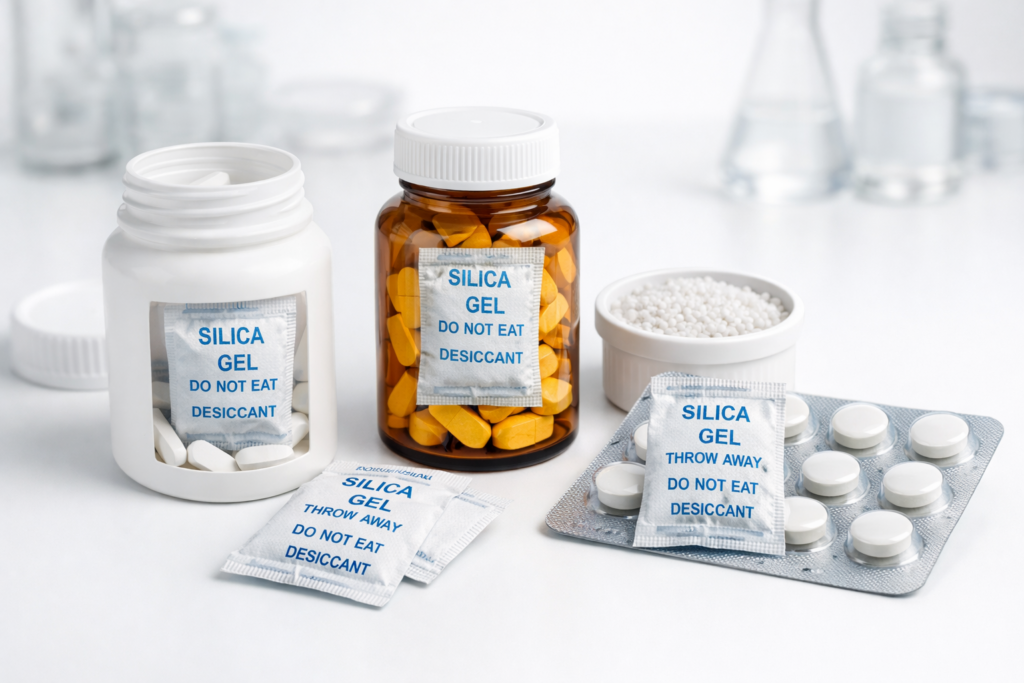
Pharmaceutical desiccants are moisture-absorbing materials placed inside packaging to regulate humidity levels and protect products from moisture-related damage.
They are commonly available in:
- Canisters (for rigid bottle packaging)
- Sachets and bags
- Strip forms
- Pre-cut units
- Custom blended formats
Sizes typically range from 0.5g to 3g for canisters and up to 500g for sachets depending on application and packaging volume.
Desiccants used in pharmaceutical packaging must comply with strict regulatory and quality standards such as:
- FDA guidelines
- USP requirements
- EU regulatory standards
- ISO 9001:2015 manufacturing standards
- GMP compliance
Types of Desiccants Used in Pharmaceutical Packaging
Choosing the right desiccant depends on humidity conditions, product sensitivity, and packaging environment. The three most widely used desiccant types include:
1. Silica Gel Desiccants
Silica gel is an amorphous, highly porous form of silicon dioxide (SiO₂). It is widely used in pharmaceutical packaging due to its moderate to high moisture adsorption capacity.
Key Advantages:
- High surface area for moisture adsorption
- Effective in low to medium humidity environments
- Chemically stable and non-toxic
- Reusable by heating (120–150°C)
- Suitable for tablets and capsules
- Available in canister and sachet formats
Silica gel is ideal for general moisture control in bottle packaging where humidity levels are moderate and consistent.
2. Molecular Sieve Desiccants
Molecular sieves are crystalline aluminosilicates (zeolites) with uniform pore structures. Unlike silica gel, they selectively adsorb molecules based on size and polarity.
Key Advantages:
- Very high adsorption efficiency at low relative humidity
- Stable at high temperatures
- Selective adsorption properties
- Ideal for highly sensitive pharmaceutical formulations
- Suitable for extreme environmental conditions
Molecular sieve desiccants are often preferred for products that require strict moisture control even at very low humidity levels or during export to humid regions.
3. Activated Carbon Desiccants
Activated carbon is highly porous and capable of adsorbing odors, volatile organic compounds (VOCs), and gases in addition to moisture.
Key Advantages:
- Adsorbs odors and organic vapors
- Effective VOC removal
- Ideal for odor-sensitive formulations
- Suitable for pharmaceutical and industrial packaging
Activated carbon desiccants are commonly used when both moisture and odor control are required.
4. Custom Blend Desiccants
In certain pharmaceutical applications, a single desiccant type may not be sufficient. Custom blend desiccants combine silica gel, molecular sieve, and activated carbon to deliver optimized performance.
Applications include:
- High-humidity export regions
- Odor-sensitive nutraceuticals
- Multi-layer packaging environments
- Controlled adsorption rate requirements
Custom blends allow pharmaceutical manufacturers to tailor moisture and gas adsorption properties precisely to product needs.
Silica Gel vs Molecular Sieve: Which is Better?
The choice between silica gel and molecular sieve depends on the application:
| Factor | Silica Gel | Molecular Sieve |
| Performance at Low Humidity | Moderate | Excellent |
| High Temperature Stability | Moderate | High |
| Selective Adsorption | No | Yes |
| Cost Efficiency | More economical | Higher cost |
| Best Use Case | Standard bottle packaging | High sensitivity drugs |
For general pharmaceutical packaging, silica gel may suffice. However, for critical drug formulations, biologics, or export markets with extreme humidity fluctuations, molecular sieve is often superior.
Canisters vs Sachets: Which Format Should You Choose?
Desiccant Canisters
- Rigid plastic containers filled with desiccant material
- Ideal for automated bottle filling lines
- Common in tablet and capsule packaging
- Clean and secure placement inside bottles
Desiccant Sachets
- Flexible porous packets
- Used in both pharma and nutraceutical packaging
- Suitable for larger packaging volumes
- Available in strip form and pre-cut format
For high-speed pharmaceutical production lines, canisters are typically preferred. Sachets are widely used for flexibility and cost efficiency.
Regulatory Compliance: What to Look For in a Desiccant Manufacturer
International pharmaceutical buyers must verify:
- FDA compliant materials
- USP adherence
- ISO 9001:2015 certification
- GMP manufacturing facility
- Raw material traceability
- Batch testing documentation
- Export readiness
Regulatory documentation is often required for audits, product registration, and stability submissions.
Selecting a certified desiccant manufacturer ensures risk mitigation and long-term compliance.
How Desiccants Extend Pharmaceutical Shelf Life
Desiccants function by creating a controlled microenvironment inside packaging. By reducing relative humidity, they:
- Slow hydrolysis reactions
- Prevent moisture-triggered degradation
- Maintain structural integrity of tablets
- Preserve potency of active ingredients
- Support stability testing outcomes
- Reduce product recalls due to moisture damage
For export markets, especially tropical or coastal regions, desiccants play a vital role in protecting products during transportation and storage.
Export Considerations for International Buyers
Pharmaceutical companies sourcing desiccants internationally should evaluate:
- Manufacturing scale and capacity
- Bulk supply capabilities
- Lead times
- Export documentation support
- Compliance with destination country standards
- Customization options
- Technical consultation availability
India has emerged as a global manufacturing hub for pharmaceutical packaging solutions due to:
- Advanced production facilities
- Regulatory adherence
- Competitive pricing
- Skilled workforce
- Export expertise
Choosing a reliable Indian desiccant manufacturer can significantly reduce cost while maintaining international quality standards.
How to Select the Right Desiccant for Your Application
When evaluating desiccants, consider:
- Product moisture sensitivity
- Packaging volume
- Expected shelf life
- Storage conditions
- Export destination climate
- Production automation compatibility
- Regulatory requirements
- Required adsorption capacity
A technical consultation with the manufacturer helps determine the correct size (0.5g – 3g for canisters or higher for sachets) and desiccant type.
The Competitive Advantage of Working with a Specialized Desiccant Manufacturer
Working with a specialized moisture control solutions provider offers:
- Technical expertise
- Customized blend solutions
- Regulatory support
- Controlled manufacturing environment
- Industry-specific formulations
- Reliable bulk export supply
- Long-term supply chain stability
In pharmaceutical packaging, precision matters. Selecting the right desiccant partner reduces operational risk and ensures product stability from production to patient delivery.
Conclusion
Moisture control in pharmaceutical packaging is not a secondary consideration — it is a core quality and compliance requirement.
Whether using silica gel for standard packaging, molecular sieve for critical moisture control, activated carbon for odor-sensitive products, or custom blends for specialized needs, selecting the correct desiccant solution directly impacts product stability, regulatory success, and global distribution.
For international pharmaceutical manufacturers and nutraceutical brands seeking FDA and USP compliant desiccant solutions, partnering with an experienced ISO-certified manufacturer ensures reliable performance, consistent quality, and seamless export supply.
Moisture damage is preventable. The right desiccant solution makes the difference.