
Moisture Control Guide for Packaging, Storage & Export (Complete Buyer Resource)
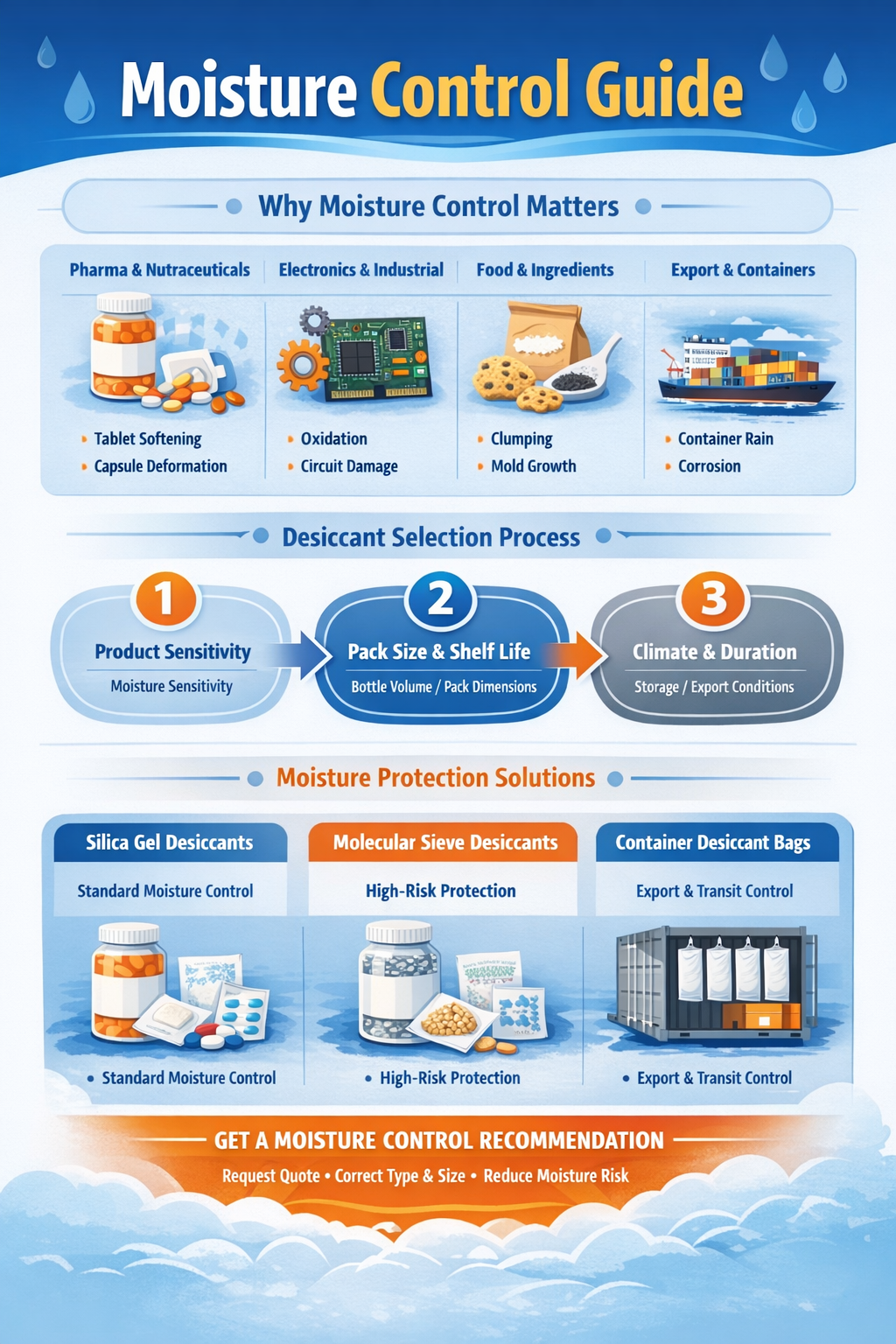
Moisture damage is preventable when you combine the right barrier packaging, correct desiccant type, and proper sizing + workflow. This pillar guide helps teams choose the right solution for pharma, nutraceutical, electronics, food ingredients, and industrial products.
- Why moisture failures happen
- How to choose silica gel vs molecular sieve
- Formats: canister, sachet, bags/pouches
- Export/container moisture strategy
- Selection framework used by Moistop
- RFQ checklist for faster quotation
- Internal links to product pages
- FAQ schema for SEO
1) Moisture Basics (Only What Matters for Packaging)
Moisture is not just “humidity.” It is the combined effect of relative humidity (RH), temperature changes, exposure time, and packaging barrier.
Relative Humidity (RH)
Higher RH increases the speed at which moisture enters packaging. Coastal regions and monsoon seasons increase moisture risk significantly.
Temperature Swings
Temperature changes cause condensation. This is why export containers face “container rain” and sudden moisture spikes inside cartons and packs.
Barrier & Ingress
Even high-quality packs allow gradual moisture ingress over time. The weaker the barrier or longer the exposure, the higher the need for desiccant support.
2) Why Moisture Failures Happen (Most Common Root Causes)
In 80% cases, failures happen due to sizing/workflow mistakes—not just “wrong supplier”.
Wrong Desiccant Size
A generic size is used without matching pack volume (cc), shelf life, and climate exposure. The desiccant saturates early and stops protecting.
Exposure Before Packing
Desiccants absorb moisture from ambient air. Long exposure during handling reduces performance inside the pack.
Wrong Format for Workflow
Choosing pre-cut when strip is needed (or vice versa) creates insertion delays, handling errors, or inconsistent performance.
Wrong Type for Risk Level
Standard silica gel works for many cases. High-risk stability and export cases may require molecular sieve evaluation.
Want Moistop to recommend the correct moisture control plan?
Share pack type, size, shelf-life target, climate, and monthly quantity. We’ll suggest type + format + supply.
3) Desiccant Types Used in Moisture Control
Pick the desiccant based on risk profile and packaging environment.
Silica Gel Desiccant
Best for standard moisture control in routine packaging and stable storage conditions.
- Common for pharma bottles, flexible packs, secondary packs
- Cost-effective for high-volume procurement
- Available in canisters, sachets, bags/pouches
Molecular Sieve Desiccant
Best for higher moisture-risk, strict stability requirements, humid conditions, export, and long storage cycles.
- Used for moisture-sensitive products and demanding shelf-life targets
- Often evaluated when there are moisture rejects/complaints
- Available in canisters, sachets, bags/pouches
4) Silica Gel vs Molecular Sieve (Clear Buyer Comparison)
This section is designed for procurement approvals and quick internal decisioning.

| Decision Factor | Silica Gel | Molecular Sieve |
|---|---|---|
| Best for | Standard moisture protection | High-risk moisture protection |
| When to choose | Routine packaging + stable conditions | Export / humid storage / strict stability |
| Common trigger | Cost + scale procurement | Rejects, complaints, sensitive products |
| Formats | Canister • Sachet • Bag/Pouch | Canister • Sachet • Bag/Pouch |
| Finalize by | Pack volume + climate + shelf-life | Risk profile + shelf-life + exposure cycle |
5) Formats & Supply (Match Your Packing Workflow)
Choose format based on packaging type and insertion workflow.
Canisters
Used in bottles. Common weights include 0.5g, 1g, 2g, 3g (based on application).
Sachets
Used in flexible packs/secondary packs. Works well for many packaging environments.
Bags / Pouches
Used for bulk packaging, cartons, and larger storage spaces.
6) Sizing Framework (How to Avoid Moisture Failures)
This is the section that reduces rejects and improves repeat procurement accuracy.
Inputs required for sizing
- Pack volume (cc) / internal air space
- Packaging barrier / material type
- Target shelf life (months)
- Storage climate (RH exposure)
- Transit duration and temperature shifts
What Moistop recommends
- Desiccant type (silica or molecular sieve)
- Format (canister / sachet / bag)
- Weight range as per application
- Supply style (strip / pre-cut)
- Ordering plan (monthly consumption)
7) Export & Container Moisture Control
Export shipments face moisture spikes due to condensation and long exposure cycles.
Condensation (“Container Rain”)
Sudden condensation forms due to temperature swings during sea transit.
Long Transit Exposure
Longer exposure requires stronger moisture control planning and proper placement.
Recommendation Inputs
Destination country, duration, cargo type, packaging, and storage conditions.
For export orders, get a recommendation based on destination + duration
Share export details in the RFQ form. Moistop will guide you on an appropriate moisture control plan.
8) RFQ Checklist (Copy-Paste for Faster Quotation)
Use this to reduce back-and-forth and get a faster quotation.
Request Recommendation + Quote
Submit your details. Our team replies with the right desiccant type, format, and quotation process.
FAQs
Short, procurement-friendly answers.
How do I choose between silica gel and molecular sieve?
Silica gel fits standard moisture control needs. Molecular sieve is evaluated for high-risk humidity exposure, strict stability targets, export, long storage cycles, or when moisture rejects have happened.
What is the fastest way to get the correct desiccant size?
Share pack volume (cc) or dimensions, shelf-life target, storage climate, packaging type, and monthly consumption in the RFQ form.
Do you supply canisters, sachets, and bags/pouches?
Yes. Moistop supports multiple formats based on the packaging workflow and requirement.
Do you support export and international B2B orders?
Yes. Mention destination, transit duration, and cargo type in the RFQ for a suitable recommendation.