
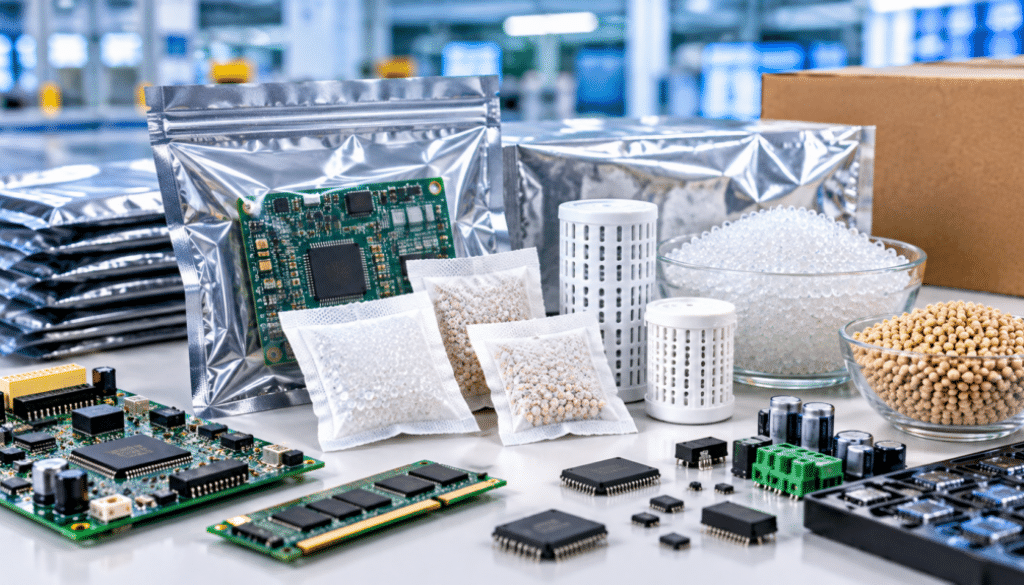
Moisture Control for Electronic Components: Packaging, Desiccants and Best Practices
Moisture control for electronic components is an essential packaging discipline for businesses that manufacture, store, transport and distribute sensitive electronic products. Electronic components can travel through multiple stages before reaching their final destination. They may move from manufacturing facilities to warehouses, assembly lines, distribution centres and international shipping networks.
During these stages, products can encounter changing humidity, temperature fluctuations and uncontrolled environmental conditions. Without an effective moisture-control strategy, unwanted humidity can create serious risks for sensitive components.
Moisture may contribute to corrosion, oxidation, surface degradation and other reliability concerns. For this reason, moisture control for electronic components should not be treated as an optional packaging improvement or an afterthought. It should be considered during the design of the complete packaging system.
An effective strategy may combine desiccants, moisture-barrier packaging, controlled sealing, proper handling and suitable storage procedures. The objective is simple: reduce unnecessary moisture exposure and create a more stable environment around the electronic component.
The right approach can help businesses prevent avoidable moisture-related problems, reduce risk and support better product protection throughout storage and transportation.
Why Moisture Control for Electronic Components Is Essential
Electronic components can be highly sensitive to environmental conditions. Even when a component appears protected, moisture can enter the packaging through ambient exposure, permeable materials, poor sealing or repeated opening.
This makes moisture control for electronic components particularly important for businesses that require dependable storage and transportation protection.
A strong moisture-control strategy can help reduce several common risks:
- Excessive humidity exposure
- Corrosion
- Oxidation
- Surface degradation
- Condensation
- Moisture-related reliability concerns
- Packaging-related exposure
- Product damage during transportation
- Long-term storage risks
- Unnecessary quality problems
Ignoring moisture exposure can create negative consequences that may not be immediately visible. A component can remain visually acceptable while still being exposed to an unsuitable environment.
That is why moisture management should be planned before the product is packed.
A reliable moisture control for electronic components solution should consider the product, packaging volume, moisture sensitivity, expected storage duration, transportation conditions and environmental exposure.
Instead of selecting a desiccant only because it is inexpensive or because a particular packet size is commonly used, businesses should evaluate the complete packaging system.
This approach creates a stronger and more reliable moisture-protection strategy.
Understanding Moisture Risks in Electronics
The first step in effective moisture control for electronic components is understanding the specific moisture risk.
Not every electronic product has the same sensitivity. Different components can have different packaging requirements, storage conditions and exposure limits.
For example, connectors may have metal surfaces that can be vulnerable to corrosion. PCB assemblies may require controlled environmental conditions. Sensors, semiconductor components and automotive electronics can also have specific handling and storage requirements.
A useful moisture-control specification should identify:
- The electronic component being protected
- Package volume
- Packaging material
- Barrier characteristics
- Seal quality
- Expected humidity exposure
- Storage period
- Transportation conditions
- Required desiccant type
- Required desiccant quantity
- Required packaging format
This information allows the packaging strategy to be designed around the actual risk rather than assumptions.
The biggest mistake is often selecting a desiccant only according to packet size or price.
A low-cost solution may not provide adequate protection if the packaging environment has significant moisture exposure. On the other hand, using an unnecessarily large quantity may increase packaging cost without providing a meaningful additional benefit.
Effective moisture control for electronic components should therefore be based on application requirements.
Major Sources of Moisture Exposure
Moisture can enter an electronics package through several routes.
Ambient Humidity
During packing and handling, components may be exposed to surrounding air. If the ambient environment has high humidity, moisture can enter the packaging before final sealing.
Packaging Permeability
Not every packaging material provides the same barrier against moisture. Some materials allow greater moisture transmission than others.
The packaging barrier should therefore be considered when designing moisture control for electronic components.
Poor Seal Quality
Even a good moisture-barrier material may become ineffective if the package is not properly sealed.
Weak seals, damaged packaging and inconsistent sealing processes can create unwanted moisture pathways.
Temperature Cycles
Temperature changes can alter the internal humidity conditions of a package. Cooling after exposure to warm humid air can increase condensation risk.
Repeated Opening
Repeatedly opening and closing packages can introduce fresh humid air.
For this reason, sensitive components should remain protected until they are ready for use.
How Humidity Can Damage Electronic Components
Moisture can create several negative effects in electronics packaging.
Corrosion is one of the major concerns. Metal surfaces can react with moisture and environmental contaminants, potentially affecting the condition and reliability of components.
Oxidation can also become a concern for certain materials and surfaces.
Surface degradation may affect the physical condition of components, particularly when exposure continues for extended periods.
Condensation is another important risk. Temperature fluctuations can cause moisture to form inside a package when warm humid air cools.
These problems can create unwanted quality issues and may contribute to product reliability concerns.
A carefully designed moisture control for electronic components system helps reduce the environmental conditions that can contribute to these risks.
Silica Gel for Electronic Components
Silica gel is a widely used desiccant for packaging applications. It is versatile, available in different formats and suitable for many moisture-control requirements.
For electronics packaging, silica gel can be supplied in compact formats such as sachets and canisters.
The suitability of silica gel depends on the component, package volume, barrier characteristics and expected environmental conditions.
One major advantage is flexibility.
A moisture control for electronic components strategy using silica gel can be adapted to different package sizes and applications.
Silica gel may be considered for:
- Electronic components
- Sensors
- Connectors
- PCB assemblies
- Industrial controls
- General electronics packaging
- Storage packaging
- Transportation packaging
However, the correct quantity should always be determined according to the actual packaging environment.
Molecular Sieve for Electronics
Molecular sieve can be considered when stronger water adsorption at low relative humidity is required.
For applications where humidity needs to be controlled more tightly, molecular sieve may provide an appropriate option depending on the component and packaging system.
The selection should not be based simply on the assumption that molecular sieve is always better than silica gel.
Instead, businesses should assess the actual moisture-control requirement.
A technically capable supplier can help compare silica gel and molecular sieve based on:
- Required humidity level
- Package volume
- Component sensitivity
- Storage period
- Transportation conditions
- Packaging barrier
- Required desiccant quantity
This application-based approach makes moisture control for electronic components more practical and reliable.
Moisture-Barrier Packaging
Desiccants are only one part of an effective moisture-control strategy.
Moisture-barrier packaging can help reduce external humidity entering the package.
For sensitive electronics, the barrier, desiccant and sealing process should be evaluated together.
A moisture-barrier package can create a controlled environment while the desiccant captures residual moisture within the sealed space.
This combination can provide a stronger approach than relying on a desiccant alone.
Important Moisture-Barrier Practices
- Use a suitable moisture barrier
- Maintain strong seal quality
- Inspect packaging before use
- Keep packages closed until required
- Reduce unnecessary exposure
- Consider humidity indicators where appropriate
- Follow component-specific handling procedures
The objective is to prevent moisture from entering while also controlling any moisture already present inside the package.
Combining Desiccants With Moisture Barriers
An effective moisture control for electronic components system often combines multiple protection layers.
The moisture barrier helps reduce moisture ingress.
The desiccant helps control residual moisture inside the sealed package.
Controlled handling reduces unnecessary exposure.
Storage procedures maintain the protection after packaging.
These elements work together.
Using only one layer may leave the product exposed to other moisture pathways.
For example, a desiccant cannot compensate indefinitely for a damaged moisture-barrier package. Similarly, excellent packaging can still face moisture exposure if it is opened repeatedly in a humid environment.
A complete system is therefore more powerful than an isolated solution.
Electronic Applications That Need Moisture Protection
Moisture protection can be relevant across a wide range of electronics applications.
Semiconductors
Semiconductor components may have defined moisture-handling and storage requirements. Appropriate packaging can help maintain controlled environmental conditions.
PCB Assemblies
Printed circuit board assemblies can be exposed to moisture during storage and transportation. Appropriate moisture protection can help reduce environmental risks.
Connectors
Metal connectors can be vulnerable to corrosion and oxidation under unsuitable environmental conditions.
Sensors
Precision sensors may require careful packaging to protect them from uncontrolled humidity.
Automotive Electronics
Automotive electronic components may experience demanding transportation and storage environments.
Industrial Controls
Industrial electronic products may be stored for extended periods before installation.
For each application, moisture control for electronic components should be designed according to the specific product and environmental requirements.
The uploaded source identifies semiconductors, PCB assemblies, connectors, sensors, automotive electronics and industrial controls as relevant applications.
Choosing the Right Desiccant
Choosing the right desiccant is one of the most important decisions in moisture control for electronic components.
The main factors include:
- Desiccant material
- Required adsorption performance
- Package volume
- Moisture sensitivity
- Storage period
- Environmental conditions
- Packaging barrier
- Required format
- Unit weight
Silica gel may be appropriate for many general applications.
Molecular sieve may be considered where lower humidity or stronger adsorption at low relative humidity is required.
The correct choice should be validated against the actual component and package.
How Much Desiccant Is Required?
There is no single universal quantity that is suitable for every electronic component.
The required quantity can depend on:
- Package volume
- Moisture exposure
- Barrier performance
- Seal quality
- Storage duration
- Transportation conditions
- Component sensitivity
- Desiccant type
Selecting the quantity only according to packet size can be a dangerous shortcut.
A better approach is to define the complete packaging environment and then determine the appropriate desiccant quantity.
This is one reason why a professional supplier should understand the application before recommending a solution.
Why Packaging and Sealing Matter
Even the best desiccant can become less effective if the package is poorly sealed.
An effective moisture control for electronic components solution should therefore include proper sealing practices.
Packaging teams should check:
- Seal consistency
- Barrier material
- Packaging damage
- Open-pack exposure
- Storage conditions
- Handling procedures
A damaged or poorly sealed moisture barrier can allow continuous humidity ingress.
That can reduce the effectiveness of the overall protection system and create avoidable moisture risks.
Moisture Control During Manufacturing
Manufacturing environments can expose components to changing humidity conditions.
The packaging process should therefore be designed to minimise unnecessary exposure.
Desiccants should remain protected from ambient air until they are required.
Production teams should also ensure that packaging is properly sealed after the component and desiccant are placed inside.
A controlled process can help reduce:
- Unnecessary humidity exposure
- Packaging errors
- Open-pack exposure
- Inconsistent sealing
- Product handling risks
Effective manufacturing procedures make moisture control for electronic components more consistent and dependable.
Moisture Control During Storage
Long-term storage creates a different challenge.
Electronic components may remain in warehouses for weeks or months before use.
During this period, environmental conditions can change significantly.
Storage procedures should therefore include:
- Properly sealed packages
- Suitable warehouse conditions
- Regular inspection
- Stock rotation
- Controlled handling
- Repackaging procedures when required
Desiccants should remain sealed until use.
If packaging is opened, the handling procedure should specify how the remaining components are protected.
This prevents avoidable moisture exposure and supports a more reliable storage system.
Moisture Control During International Shipping
International transportation can expose electronic products to multiple climates.
A shipment may move from a dry region to a humid region and then through additional temperature changes.
These conditions make moisture control for electronic components particularly important during export.
The packaging strategy should consider:
- Origin climate
- Destination climate
- Shipping duration
- Container conditions
- Packaging barrier
- Cargo configuration
- Seasonal conditions
Individual component packaging and container-level moisture protection should be treated as separate layers.
Moisture Control for Export Containers
Export containers can experience condensation and changing humidity during transportation.
A container-level moisture-control solution can help manage the moisture environment around the cargo.
However, container desiccants should not replace proper product packaging.
Instead, exporters should use multiple protection layers where appropriate.
Export Protection Checklist
- Inspect the container before loading
- Ensure cargo is dry
- Use suitable moisture-barrier packaging
- Use individual desiccants where required
- Consider container-level desiccants
- Review route and seasonal conditions
- Define storage inspection procedures
The uploaded source specifically notes that electronics may move through several climates and that individual packaging and container-level protection are separate moisture-control layers.
Humidity Indicators and Monitoring
Humidity indicators can provide additional visibility into the moisture environment.
For sensitive electronic products, monitoring can help businesses understand whether the package remained within the intended environmental conditions.
A humidity indicator may be considered when the customer’s handling and quality procedures require additional monitoring.
The combination of:
Barrier + Desiccant + Humidity Indicator + Controlled Handling
can create a more comprehensive moisture-control strategy.
This can help businesses identify potential problems before they become serious product-quality concerns.
Supplier Quality and Documentation
Choosing a reliable supplier is critical for successful moisture control for electronic components.
A supplier should provide clear information about:
- Material
- Unit weight
- Package dimensions
- Format
- Batch identification
- Storage requirements
- Relevant quality documentation
Moistop identifies electronics as an industry served and states that its Hyderabad facility uses automated filling and sealing, camera-based inspection, an in-house quality laboratory and batch-level traceability.
These manufacturing controls can support repeatable packaging components.
For businesses purchasing desiccants regularly, batch-level traceability can also make quality management more effective.
How to Select a Reliable Desiccant Supplier
The right supplier should offer more than a basic product.
Businesses should evaluate:
Product Quality
The supplier should provide consistent material, unit weight and packaging.
Production Capability
A supplier should be capable of supporting repeat requirements and planned volumes.
Technical Knowledge
The supplier should understand the relationship between component sensitivity, packaging and desiccant selection.
Documentation
Specifications and relevant quality records should be available according to the application.
Customisation
Different electronic products may require different formats, unit weights or packaging configurations.
Supply Reliability
Unexpected shortages can disrupt packaging operations. A dependable supplier relationship can support better production planning.
A strong moisture control for electronic components program depends on both product quality and supply consistency.
Designing an Effective Moisture-Control Specification
A strong specification should clearly define the complete packaging environment.
The specification can include:
- Component or product type
- Part family
- Package volume
- Packaging material
- Barrier characteristics
- Seal method
- Desiccant chemistry
- Desiccant unit weight
- Desiccant format
- Storage duration
- Shipping conditions
- Environmental exposure
- Required documentation
This prevents confusion between procurement, quality and production teams.
The uploaded source recommends identifying the component, package volume, barrier material, sealing method, storage period, shipping conditions, desiccant chemistry and unit weight, followed by validation in the complete packaging system.
Common Moisture-Control Mistakes to Avoid
Several mistakes can weaken an otherwise good moisture-control strategy.
Choosing Only by Price
The cheapest option may not provide the required protection.
Selecting Only by Packet Size
Packet size alone does not determine the correct moisture-control requirement.
Ignoring Seal Quality
Poor sealing can allow moisture ingress despite the presence of a desiccant.
Leaving Desiccants Exposed
Desiccants can interact with ambient moisture before being placed inside the final package.
Ignoring Storage Conditions
A product can remain exposed to moisture even after packaging if storage conditions are unsuitable.
Treating Container and Product Protection as the Same
Individual packaging and container-level moisture protection have different roles.
Changing Specifications Without Review
For repeat production, uncontrolled changes to desiccant type, weight or format can create inconsistency.
Avoiding these negative practices can significantly strengthen moisture control for electronic components.
Benefits of a Strong Moisture-Control Strategy
A properly designed strategy can provide several important advantages.
Better Product Protection
Effective moisture management can help protect sensitive components during storage and transportation.
Reduced Moisture Risk
Desiccants and barriers can reduce exposure to unwanted humidity.
Improved Packaging Consistency
A defined specification can help production teams follow the same process.
Stronger Supply-Chain Protection
Appropriate moisture protection can support electronics during long-distance transportation.
Reduced Avoidable Damage
Preventing moisture exposure can help reduce the risk of corrosion, oxidation and other environmental problems.
Better Quality Management
Batch traceability and documented specifications can support repeatable procurement and quality processes.
More Reliable Storage
Properly sealed packaging and controlled handling can help protect components during extended storage.
The overall objective of moisture control for electronic components is to create a controlled and dependable packaging environment from manufacturing through final use.
Frequently Asked Questions (5)
1. What is moisture control for electronic components?
Moisture control for electronic components is the use of desiccants, moisture barriers and controlled handling procedures to reduce humidity exposure during manufacturing, storage and transportation.
The strategy can include silica gel, molecular sieve, moisture-barrier packaging, controlled sealing and humidity monitoring depending on the application.
2. Is silica gel suitable for electronics?
Yes. Silica gel is commonly used for many electronics packaging applications because it is versatile and available in compact formats.
The required quantity and format depend on package size, environmental exposure, component sensitivity and storage conditions.
3. When is molecular sieve useful for electronic components?
Molecular sieve can be considered when stronger moisture adsorption at low relative humidity is required.
The final choice should be based on the component, package and required environmental conditions.
4. Should electronic components use a moisture barrier with desiccant?
For moisture-sensitive components, a moisture barrier combined with a desiccant can provide a stronger protection system than using a desiccant alone.
The barrier reduces moisture ingress while the desiccant helps control residual moisture inside the sealed package.
5. Does Moistop supply moisture-control solutions for electronics?
Moistop identifies electronics as an industry served and lists silica gel and molecular sieve products in multiple formats, including sachets, canisters, bags and pouches. The company also states that its Hyderabad facility includes automated filling and sealing, camera-based inspection, an in-house quality laboratory and batch-level traceability.
Conclusion
Effective moisture control for electronic components begins with understanding the component, packaging system and environmental exposure.
Humidity can create serious and avoidable risks during manufacturing, storage and transportation. Corrosion, oxidation, surface degradation, condensation and other moisture-related problems can affect sensitive electronic products when environmental conditions are not properly controlled.
A powerful moisture-control strategy combines the right desiccant with suitable moisture-barrier packaging, reliable sealing, controlled handling and appropriate storage procedures.
Silica gel can provide versatile moisture protection for many packaging applications, while molecular sieve can be considered when stronger adsorption at low relative humidity is required.
The correct quantity should not be selected only by packet size or price. Instead, businesses should consider package volume, component sensitivity, barrier performance, storage period and transportation conditions.
For international shipments, individual component packaging and container-level moisture protection should be treated as separate but complementary protection layers.
Selecting a reliable supplier is equally important. Consistent product specifications, technical support, quality documentation, manufacturing capability and batch traceability can help create a more dependable supply chain.
Moistop identifies electronics as an industry it serves and offers silica gel and molecular sieve in different formats. Its stated Hyderabad manufacturing capabilities include automated filling and sealing, camera-based inspection, an in-house quality laboratory and batch-level traceability.
By designing the packaging system carefully and selecting an appropriate moisture control for electronic components solution, businesses can reduce moisture-related risks, protect sensitive electronics and build a stronger, more reliable packaging process.