Bulk Desiccant Supplier: How to Choose the Right Partner for Reliable Moisture Control
A reliable bulk desiccant supplier is an important part of moisture-control planning for manufacturers, exporters, packaging companies and industrial businesses. Moisture can enter products and packaging during manufacturing, storage and transportation, creating problems that may only become visible after a shipment has reached its destination. The right desiccant solution helps manage humidity inside the selected packaging environment and supports the protection strategy for moisture-sensitive products.
Moisture exposure can affect different products in different ways. Metal components may be vulnerable to corrosion, pharmaceutical and nutraceutical products may require protection from humidity, electronics may need controlled packaging conditions, and exported goods can face changing temperature and humidity during long-distance transportation.
When choosing a bulk desiccant supplier, businesses should look beyond price and compare the material, format, unit weight, packaging integrity, manufacturing controls, documentation, production capacity and delivery reliability. A supplier should also understand how the desiccant fits into the complete packaging system.
Moistop provides desiccant solutions in different formats, including silica gel and molecular sieve products, for pharmaceutical, nutraceutical, medical, export, industrial and consumer applications. This guide explains the key factors businesses should consider before selecting a bulk desiccant supplier for recurring moisture-control requirements.
Why Bulk Desiccants Matter in Manufacturing and Supply Chains
Moisture damage can affect products long after they leave the production facility. Humidity may contribute to corrosion, mould, clumping, staining, odour, packaging weakness and changes in product condition. For businesses purchasing desiccants in large quantities, moisture control is therefore not simply a packaging accessory. It is part of product protection and supply-chain risk management.
A bulk desiccant supplier should help customers understand the moisture risk before recommending a product. The first questions should include what product is being protected, the size of the package, the expected storage period, transportation conditions and likely humidity exposure.
This approach is more useful than choosing a desiccant only according to packet size or purchase price. The same desiccant format may not be suitable for every application because packaging volume, environmental exposure and moisture sensitivity can vary significantly.
Key Factors for High-Volume Buyers
- Consistent desiccant unit weights and packaging
- Stable sealing and physical integrity
- Batch identification and traceability
- Technical support for application selection
- Reliable production capacity
- Predictable lead times
- Relevant specifications and quality documentation
- Suitable packaging formats
- Consistent supply for repeat orders
A professional bulk desiccant supplier should be able to support customers not only during the first purchase but also during repeat orders and future application changes.
Understanding Desiccant Materials
Different desiccant materials have different moisture-control characteristics. A bulk desiccant supplier should explain these differences clearly so customers can select the material according to the application rather than treating all desiccants as identical.
Silica gel is widely used for general moisture control and can be supplied in sachets, canisters, bags and pouches. Molecular sieve is used when stronger water adsorption at lower relative humidity is required. Activated carbon can be used in applications where moisture control is combined with odour or certain volatile-compound control.
The final selection should consider the product, package, storage environment, transportation conditions and required protection period.
| Desiccant Material | Typical Role | Selection Consideration |
|---|---|---|
| Silica Gel | General moisture control | Versatile for many packaging applications |
| Molecular Sieve | Low-humidity protection | Useful when stronger water adsorption is required |
| Activated Carbon | Moisture plus odour/volatile control | Application-specific selection |
Choosing the correct material is important because the performance expected from a desiccant depends on the complete packaging environment.
Silica Gel for General Moisture Control
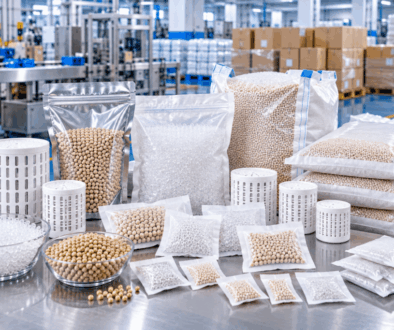
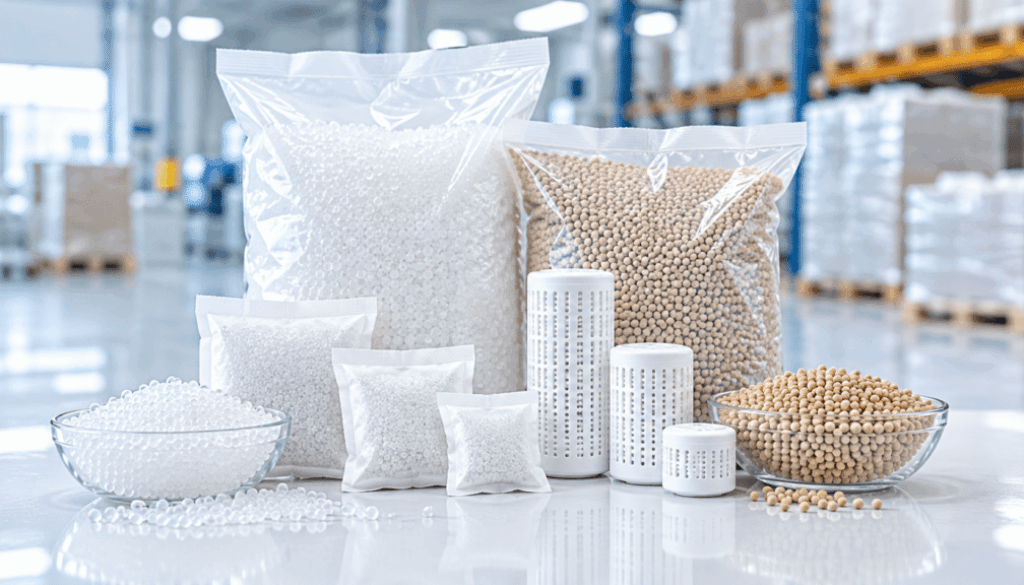
Silica gel is one of the most widely used desiccant materials for packaging. Its flexibility makes it suitable for different package sizes and applications. A bulk desiccant supplier may provide silica gel in sachets, canisters, bags or pouches so that the format can be matched to the package.
For bottle packaging, a compact canister may be preferred because it can remain stable inside the container. Sachets can be useful in cartons and consumer packaging, while larger bags and pouches can provide higher capacity for industrial goods, equipment and cargo.
The correct quantity should not be selected only by habit. Package volume, moisture sensitivity, barrier properties, expected storage period and environmental exposure should be considered.
For high-volume production, consistency is particularly important. If every package receives a controlled and consistent desiccant unit, the packaging process becomes easier to standardise.
A bulk desiccant supplier can also help businesses compare different formats depending on the packaging process. The final product should be validated within the actual packaging system, especially for moisture-sensitive or regulated applications.
Molecular Sieve for Low-Humidity Applications
Molecular sieve has a strong affinity for water and can be considered for applications that require lower humidity conditions. It is particularly relevant when the customer needs stronger moisture adsorption at low relative humidity.
The use of molecular sieve does not automatically mean that a smaller quantity will always provide the correct protection. The complete packaging environment still matters. A bulk desiccant supplier should consider the product, package volume, sealing, expected exposure and target humidity before recommending the appropriate quantity and format.
Molecular sieve can be supplied in different packaging configurations depending on the application. Canisters and sachets can support smaller packages, while larger bags or pouches may be considered for industrial requirements.
For applications where moisture sensitivity is high, customers should clearly communicate their requirements to the supplier. This allows the supplier to recommend an appropriate product format rather than simply providing a standard desiccant.
Activated Carbon for Additional Protection
Activated carbon serves a different function from conventional moisture-only desiccants. It can be included when moisture control is combined with a need to address odour or certain volatile compounds.
For this reason, businesses should describe the complete protection objective when contacting a bulk desiccant supplier.
The selection of activated carbon should be application-specific. Packaging dimensions, product sensitivity, expected storage conditions and the additional odour or volatile-control requirement should all be considered before the final format is approved.
This type of application demonstrates why supplier consultation can be valuable. A business may need moisture control as well as additional protection, and the packaging solution should be designed around the complete requirement.
Choosing the Correct Desiccant Format
The physical format of a desiccant is just as important as the material. A bulk desiccant supplier should be able to provide formats that fit the customer’s production and packaging process.
A product that performs well chemically may still be unsuitable if its dimensions, sealing or handling characteristics do not fit the packaging line.
Common Desiccant Formats
- Canisters for bottles and regulated packaging
- Sachets for cartons, packs and smaller enclosed spaces
- Bags for larger industrial packaging
- Pouches for bulk and cargo moisture control
- Custom or OEM formats for specific packaging requirements
Format selection should consider available space, placement, required unit weight, packaging material and handling process.
For repeat production, using an approved standard format can improve consistency across manufacturing batches. It can also simplify procurement because the same approved specification can be used for future orders.
How to Evaluate a Bulk Desiccant Supplier
Choosing a bulk desiccant supplier requires a structured procurement review. The supplier should be assessed on technical capability as well as commercial terms.
A low purchase price may not represent the lowest total cost if inconsistent quality results in rejected shipments, damaged inventory, production interruptions or repeated packaging trials.
Product Specification
Ask for the exact material type, available unit weights, format dimensions, packaging material and storage requirements.
The specification should be clear enough that future orders can be compared with the original approved product. This is particularly important for businesses with regular monthly consumption.
Quality and Documentation
Quality documentation can include product specifications, batch information, relevant certificates and other records required by the customer’s quality system.
For regulated applications, buyers should verify current documents and confirm their scope and applicability before approval.
Production Capacity and Lead Time
High-volume customers should discuss monthly consumption, seasonal demand, safety stock and expected lead times.
A reliable bulk desiccant supplier should be able to discuss production planning rather than treating every large order as an urgent one-time request.
Technical Support
Technical support is especially important when the buyer is unsure about desiccant material, unit weight or format.
A supplier should be able to review application details and explain the factors that influence moisture-control performance.
Bulk Desiccants for Export Cargo
Export cargo can experience significant changes in temperature and humidity during transportation. A container may move through different climates while remaining enclosed for days or weeks.
When warm humid air cools, condensation can form on container surfaces and potentially affect cargo.
High-capacity desiccants designed for cargo applications can help reduce water vapour inside the container. However, desiccant should be treated as one part of a complete moisture-control system.
Cargo should be dry, packaging should be appropriate and the container should be inspected before loading.
Important Export Planning Factors
| Factor | Why It Matters | Information to Provide |
|---|---|---|
| Container Size | Influences enclosed air volume | 20-ft, 40-ft or 40-ft HC |
| Cargo Type | Determines moisture risk | Material and packaging details |
| Transit Duration | Determines exposure period | Expected days or weeks |
| Route and Season | Affects humidity and temperature | Origin, destination and timing |
Individual package desiccants and container-level desiccants should be treated as different protection layers.
The small desiccant used inside a product package is not automatically suitable for protecting an entire shipping container. Exporters should provide container dimensions, cargo type, packaging and expected transit duration when discussing requirements with a bulk desiccant supplier.
Manufacturing Quality and Batch Traceability
Manufacturing controls are important when a customer depends on repeat supply.
Moistop states that its Hyderabad facility includes a 100,000-class cleanroom, automated filling and sealing, camera-based inspection, an in-house quality laboratory and batch-level traceability.
These details are relevant to customers evaluating production consistency and traceability.
Batch traceability can support quality investigations and repeat-order control. When a customer has a question about a shipment, batch identification helps connect the supplied product to a defined production run and supporting records.
Customers should still conduct their own supplier qualification and request the documents required by their internal quality process. Requirements can vary according to industry, product and market.
Building a Practical Procurement Specification
A clear procurement specification makes it easier for both the customer and the bulk desiccant supplier to maintain consistency.
The specification should identify the material, unit weight, format, packaging, application and expected consumption.
Recommended Specification Points
- Desiccant chemistry and grade
- Unit weight and acceptable tolerance
- Canister, sachet, bag or pouch format
- Packaging material and sealing requirements
- Product or cargo being protected
- Expected monthly quantity
- Storage conditions
- Required quality documents
- Lead-time expectations
- Change-control requirements
For export applications, the specification can also include container size, cargo type, route, transit duration and seasonal conditions.
Where appropriate, a trial should be conducted using the actual packaging system before commercial approval.
A well-defined specification also reduces confusion between procurement and production teams. Everyone works with the same approved product requirements.
Manufacturer-Direct and Custom Supply
Manufacturer-direct sourcing can provide direct access to technical information, production planning and customization.
This can be useful when a business requires a non-standard sachet, a particular canister dimension, private-label packaging or recurring monthly production.
Moistop lists OEM and private-label manufacturing among its custom solutions.
For businesses with multiple product lines, working with one qualified manufacturer across several formats can simplify procurement and reduce the need to manage numerous specifications.
Customization should still follow a controlled approval process. The customer should define the required dimensions, unit weight, material, packaging and quality requirements before the customized product enters regular production.
Storage and Handling of Desiccants
Desiccants begin interacting with moisture when exposed to ambient air. Unused material should therefore remain sealed in its protective packaging until it is needed.
Warehouses should follow the supplier’s storage guidance and protect cartons or outer packaging from damage.
Good Storage Practices
- Keep unused desiccants sealed
- Avoid unnecessary exposure before use
- Use stock rotation
- Protect outer packaging from damage
- Minimize open-pack exposure on production lines
- Follow supplier storage recommendations
Production teams should minimize the time desiccant units remain exposed before final sealing.
This simple control helps preserve available moisture-adsorption capacity and supports consistent performance.
Planning Long-Term Desiccant Supply
A long-term relationship with a bulk desiccant supplier should include approved specifications, demand forecasts, agreed lead times, quality documentation and change-control expectations.
This becomes especially important when monthly consumption is high or when the desiccant is part of a regulated packaging process.
Procurement teams should establish reorder points and safety stock according to their own production requirements.
Seasonal demand and new product launches should be included in forecasts.
If a package, product, route or storage condition changes, the moisture-control specification should be reviewed before continuing with the previous configuration.
The objective is a predictable supply program rather than repeated emergency purchases. A technically capable bulk desiccant supplier should be able to support the customer as packaging volumes and applications change.
5. Frequently Asked Questions
1. What does a bulk desiccant supplier provide?
A bulk desiccant supplier provides moisture-absorbing materials in bulk or application-specific formats, along with product specifications, packaging options and relevant quality documentation.
The exact format and quantity should be selected according to the customer’s moisture-control requirement.
2. Which desiccant is commonly used for general packaging?
Silica gel is widely used for general packaging moisture control.
Molecular sieve can be considered when stronger water adsorption at low relative humidity is required, while activated carbon can be relevant when moisture control is combined with odour or certain volatile-compound control.
3. Can bulk desiccants be used for export cargo?
Yes. High-capacity bags, pouches and container moisture-control solutions can be used as part of an export protection plan.
Quantity and placement should be selected according to container size, cargo type, route, season and transit duration.
4. What should I provide when requesting a bulk desiccant quotation?
Provide the application, product or cargo type, package or container dimensions, preferred format if known, estimated monthly quantity, destination and documentation requirements.
These details help the bulk desiccant supplier understand the moisture-control environment and recommend a suitable solution.
5. Does Moistop manufacture desiccant solutions in India?
Moistop states that it manufactures desiccant solutions in Hyderabad, India, and lists silica gel, molecular sieve and activated carbon products in formats including canisters, sachets, bags and pouches.
Conclusion
Selecting the right bulk desiccant supplier involves more than comparing price per packet or kilogram.
Businesses should evaluate the complete moisture-control requirement, including desiccant chemistry, unit weight, format, packaging, manufacturing controls, quality documentation, production capacity and lead time.
Silica gel can support general moisture control, molecular sieve can be considered for lower-humidity applications, and activated carbon can provide additional protection where odour or certain volatile compounds are part of the requirement.
For export cargo, high-capacity solutions should be combined with dry cargo, appropriate packaging and container inspection.
Moistop’s stated Hyderabad manufacturing capabilities, product formats and batch traceability can be considered when evaluating a bulk desiccant supplier for recurring industrial, pharmaceutical, export and packaging requirements.
Customers should verify the latest technical specifications, certifications and product details directly with the supplier before procurement approval.