Pharma Bottle Desiccant Supplier with ISO Certification: What Pharmaceutical Buyers Should Check
Pharmaceutical and nutraceutical products require carefully controlled packaging because moisture can affect tablets, capsules, powders and hygroscopic formulations. Choosing the right pharma bottle desiccant supplier with ISO certification can help pharmaceutical manufacturers build a reliable moisture-control system while maintaining appropriate quality, documentation and packaging controls.
A pharmaceutical desiccant is not simply a small moisture absorber placed inside a bottle. The correct solution should be evaluated according to the formulation, bottle volume, closure, environmental exposure, shelf-life requirements, manufacturing process and validated packaging configuration.
For pharmaceutical companies, nutraceutical manufacturers and packaging teams, selecting an experienced pharma bottle desiccant supplier with ISO certification can be an important part of supplier qualification. Certification, manufacturing controls, traceability, product consistency and documentation can all contribute to a stronger packaging system.
This guide explains what pharmaceutical bottle desiccants are, why ISO certification matters, how to compare silica gel and molecular sieve, what documents to request, how to select desiccant weight and format, and what to consider when establishing a long-term supply relationship.
Why Pharmaceutical Bottles Need Desiccants
Moisture can become a significant packaging concern for pharmaceutical and nutraceutical products. Tablets, capsules, powders and hygroscopic formulations may be sensitive to humidity and environmental exposure.
A bottle desiccant can help control humidity in the bottle headspace when the bottle, closure and desiccant are properly designed and validated together. Therefore, a pharma bottle desiccant supplier with ISO certification should understand both moisture-control technology and pharmaceutical packaging requirements.
Moisture Risks in Pharmaceutical Packaging
Excessive moisture exposure can create unwanted problems such as:
- Product quality concerns
- Changes in physical characteristics
- Packaging-related problems
- Reduced stability in moisture-sensitive products
- Increased risk during storage
- Uncontrolled humidity inside the package
A properly selected desiccant can help create a more controlled environment inside the bottle.
Why Correct Selection Matters
Choosing a desiccant simply because it is inexpensive or because a particular gram weight is commonly used can be a weak approach.
A better approach considers:
- Product sensitivity
- Bottle volume
- Closure performance
- Expected shelf life
- Environmental exposure
- Required moisture-control performance
- Manufacturing and filling process
- Packaging validation requirements
This is why working with a qualified pharma bottle desiccant supplier with ISO certification can be valuable for pharmaceutical packaging projects.
What Is a Pharma Bottle Desiccant?
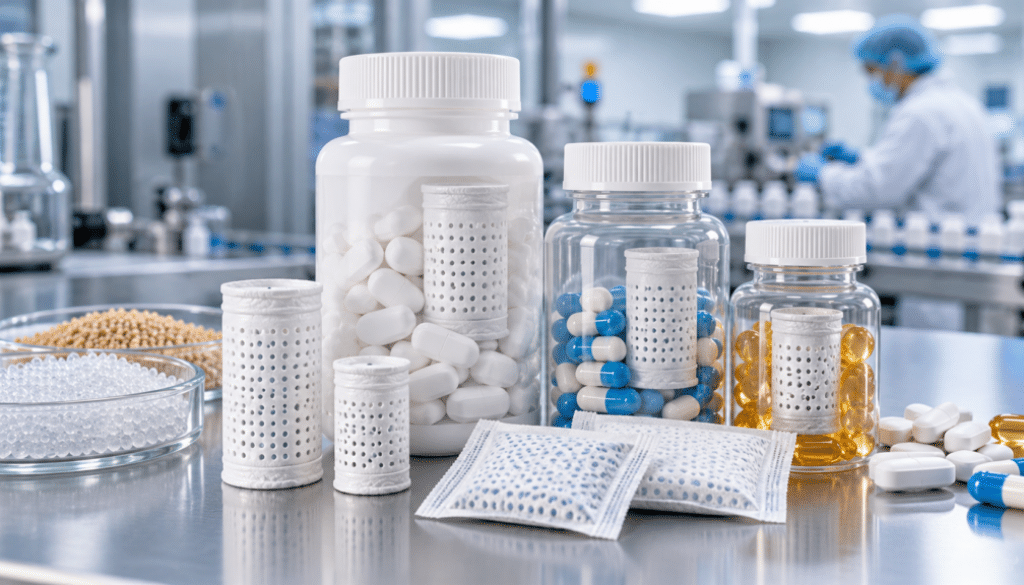
A pharma bottle desiccant is a compact moisture-control component designed to fit inside a primary pharmaceutical package.
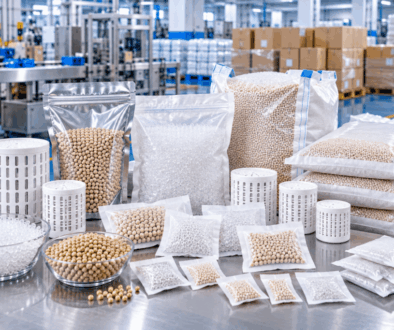
According to the supplied source material, Moistop lists silica gel, molecular sieve and activated carbon canisters, along with sachets. The listed silica gel and molecular sieve canister ranges are 0.5g–3g, while activated carbon canisters are listed in 0.5g–2g ranges.
Silica Gel Canisters
Silica gel is commonly used for general bottle moisture protection.
The supplied material lists silica gel canisters in the 0.5g–3g range for bottle moisture-control applications.
Molecular Sieve Canisters
Molecular sieve can be considered when stronger water adsorption at lower relative humidity is required.
The source lists molecular sieve canisters in the 0.5g–3g range and identifies lower-humidity protection as a potential application.
Activated Carbon Canisters
Activated carbon canisters can be considered for applications involving moisture together with odour or volatile-control requirements.
The supplied material lists activated carbon canisters in the 0.5g–2g range.
Why ISO Certification Matters for a Pharma Bottle Desiccant Supplier
When pharmaceutical manufacturers evaluate a pharma bottle desiccant supplier with ISO certification, quality systems and documentation can become important parts of supplier qualification.
The supplied source states that Moistop’s website lists ISO 15378:2017 and cGMP in its pharmaceutical moisture-protection section and ISO 9001:2015 in its quality section. It also references FDA, REACH and RoHS-related compliance information. The source specifically advises buyers to verify current certificates and scope before qualification.
Verify the Current Certificate
A certificate should not simply be accepted because it appears on a website.
Pharmaceutical buyers should:
- Request the current certificate
- Verify the issuing body
- Check certificate validity
- Confirm the certification scope
- Confirm the relevant manufacturing facility
This creates a stronger and more transparent supplier-qualification process.
Certification Is Only One Part of Supplier Qualification
ISO certification can provide useful evidence of a quality-management framework, but pharmaceutical customers should still evaluate the supplier’s complete manufacturing and documentation system.
Important areas may include:
- Manufacturing controls
- Product specifications
- Traceability
- Batch documentation
- Packaging controls
- Storage requirements
- Change control
- Supply consistency
Silica Gel vs Molecular Sieve for Pharmaceutical Bottles
One of the most important decisions when choosing a pharma bottle desiccant supplier with ISO certification is selecting the appropriate desiccant material.
Silica Gel
Silica gel is commonly used for general moisture protection.
It can be suitable when the pharmaceutical packaging application requires general humidity control and the formulation, bottle and environmental conditions support its use.
Molecular Sieve
Molecular sieve can be considered when stronger water adsorption at lower relative humidity is required.
The choice between silica gel and molecular sieve should not be based purely on habit or price.
Instead, pharmaceutical manufacturers should consider:
- Formulation sensitivity
- Bottle volume
- Closure performance
- Environmental exposure
- Shelf-life requirements
- Validated packaging requirements
The supplied source specifically recommends making the choice based on the formulation and complete packaging configuration rather than simply selecting the material by routine practice.
Pharmaceutical-Grade Manufacturing and Cleanroom Controls
Manufacturing conditions are another important factor when selecting a pharma bottle desiccant supplier with ISO certification.
The supplied source states that Moistop describes a pharmaceutical-grade facility in Hyderabad with:
- 100,000-class cleanroom
- Automated filling and sealing
- Camera-based inspection
- In-house quality laboratory
- Batch-level traceability
These controls can support manufacturing consistency, although customers should still complete their own supplier-qualification process.
Why Manufacturing Controls Matter
A strong manufacturing environment can help reduce unwanted inconsistencies.
For pharmaceutical packaging, manufacturers may need to maintain control over:
- Filling
- Sealing
- Inspection
- Packaging
- Batch identification
- Quality checks
- Storage
- Documentation
A professional pharma bottle desiccant supplier with ISO certification should be able to provide appropriate technical and quality information to support the customer’s qualification process.
Documents to Request from a Pharma Bottle Desiccant Supplier
Documentation is an essential part of pharmaceutical supplier qualification.
A pharmaceutical customer may request:
- ISO certificate and scope
- Product specification
- Batch traceability information
- Certificate of Analysis or Certificate of Conformity
- Compliance statements
- Packaging information
- Storage instructions
- Quality agreement where required
The supplied material recommends requesting current documentation rather than relying only on claims presented on a website.
Why Documentation Matters
Good documentation can help pharmaceutical manufacturers:
- Review supplier suitability
- Maintain quality records
- Investigate complaints
- Track batches
- Support audits
- Maintain approved supplier records
- Manage future changes
A supplier that can provide clear and consistent documentation can make the qualification process more organised and transparent.
How to Select Desiccant Weight and Format
Choosing the correct desiccant weight is an important part of pharmaceutical packaging design.
The appropriate unit weight depends on:
- Formulation sensitivity
- Bottle volume
- Closure
- Shelf-life target
- Environmental exposure
- Packaging configuration
A supplier can provide standard formats and technical information, while the pharmaceutical manufacturer should validate the final configuration within its own packaging system.
Avoid Under-Sizing
Using an insufficient desiccant configuration can create unwanted moisture-control risks.
Avoid Overlooking the Filling Process
The selected format should fit properly into the pharmaceutical manufacturer’s filling and capping process.
The desiccant should not create unnecessary problems during:
- Bottle filling
- Desiccant insertion
- Capping
- Packaging
- Transport
- Storage
A reliable pharma bottle desiccant supplier with ISO certification should be able to discuss format and technical requirements with the customer.
Compatibility, Handling and Storage
The desiccant should remain intact throughout filling, capping, transportation and use.
Correct handling is important because even a high-quality desiccant can lose effectiveness when it is unnecessarily exposed to ambient humidity before use.
Keep Unused Desiccants Sealed
Unused desiccants should remain sealed until required.
Ambient humidity can consume some of the available moisture-adsorption capacity.
Protect Packaging Integrity
Production teams should maintain appropriate packaging integrity and avoid damaging the desiccant during handling.
Define Line-Handling Procedures
Manufacturers should establish clear procedures for:
- Opening packs
- Handling unused units
- Protecting desiccants during line setup
- Storage
- Production documentation
These procedures help create a more controlled and repeatable packaging process.
Batch Traceability and Change Control
For pharmaceutical applications, traceability can be a powerful quality-control tool.
Batch traceability connects delivered desiccants to a particular production run and can support:
- Complaint investigation
- Quality records
- Batch review
- Supplier monitoring
- Product identification
The supplied source also highlights the importance of change control.
If materials, packaging film or process conditions change, the pharmaceutical customer may require notification and impact assessment under the agreed quality procedure.
Why Change Control Is Important
Unexpected changes can create uncertainty for pharmaceutical manufacturers.
A controlled change-management process can help ensure that important changes are:
- Documented
- Communicated
- Reviewed
- Assessed
- Approved where necessary
This can make long-term supplier relationships more reliable.
Long-Term Pharmaceutical Desiccant Supply
For companies purchasing pharmaceutical desiccants regularly, choosing a supplier should involve more than evaluating a single shipment.
A strong long-term supply program may include:
- Approved product specification
- Current certificates
- Forecast quantities
- Lead times
- Storage requirements
- Change-control expectations
- Batch traceability
- Consistent packaging
The supplied material states that Moistop positions its pharmaceutical desiccant solutions for regulated applications and supplies canisters and sachets. It also recommends that buyers request current technical documents and validate the selected product in their own packaging system.
Supply Reliability
Pharmaceutical production schedules depend on predictable packaging-material availability.
A reliable pharma bottle desiccant supplier with ISO certification should be able to support repeat orders against an approved specification.
6. Important Qualification Areas
| Qualification Area | What to Verify |
|---|---|
| Certification | Current certificate and scope |
| Product | Material and weight |
| Manufacturing | Facility and process controls |
| Quality | Quality documentation |
| Traceability | Batch identification |
| Supply | Capacity and lead time |
The supplied source presents these areas as part of a practical supplier-qualification framework.
Common Mistakes When Selecting a Pharma Bottle Desiccant Supplier
Choosing the wrong supplier or unsuitable desiccant configuration can create unnecessary risks.
Selecting Only by Price
The cheapest product may not provide the technical documentation, manufacturing controls or packaging compatibility required by the application.
Ignoring Product Sensitivity
Different pharmaceutical formulations can have different moisture sensitivities.
Choosing Desiccant Weight Without Validation
A standard weight should not automatically be treated as the correct solution for every bottle.
Failing to Verify Certifications
Certification information should be checked for current validity and scope.
Ignoring Traceability
Batch identification can become important during quality investigations and supplier reviews.
Failing to Review Changes
Changes to raw materials, packaging or manufacturing processes may require notification and assessment.
Avoiding these common mistakes can help pharmaceutical manufacturers establish a more controlled and reliable desiccant procurement process.
Benefits of Choosing a Qualified Pharma Bottle Desiccant Supplier
A carefully evaluated supplier can support several important areas of pharmaceutical packaging.
Better Moisture Control
The appropriate desiccant can help manage humidity inside the pharmaceutical bottle.
Stronger Quality Management
Documented quality systems can support supplier qualification and ongoing monitoring.
Improved Traceability
Batch-level information can help connect delivered products with manufacturing records.
Consistent Supply
An approved specification and planned supply process can support repeat pharmaceutical production.
Better Packaging Compatibility
Technical evaluation can help manufacturers select an appropriate material, weight and format.
More Confident Supplier Qualification
Current certifications, documentation and manufacturing information can make the evaluation process more structured.
How to Choose the Right Pharma Bottle Desiccant Supplier with ISO Certification
Before approving a supplier, pharmaceutical manufacturers can use the following checklist.
Step 1: Define the Product Requirement
Identify:
- Formulation
- Moisture sensitivity
- Bottle size
- Closure
- Shelf-life requirement
Step 2: Select the Desiccant Type
Evaluate:
- Silica gel
- Molecular sieve
- Activated carbon
- Canister
- Sachet
Step 3: Review Supplier Certifications
Request current certificates and verify their scope.
Step 4: Evaluate Manufacturing Controls
Review:
- Facility
- Cleanroom controls
- Filling
- Sealing
- Inspection
- Quality laboratory
- Traceability
Step 5: Request Technical Documents
Obtain:
- Product specification
- Certificate of Analysis or Conformity
- Compliance information
- Storage guidance
- Packaging details
Step 6: Validate the Final Packaging Configuration
The pharmaceutical manufacturer should validate the chosen desiccant within its own packaging system.
Frequently Asked Questions
What should I look for in a pharma bottle desiccant supplier with ISO certification?
Look at relevant certification and scope, pharmaceutical manufacturing controls, cleanroom capability, traceability, consistent formats and supporting documentation.
What certifications does Moistop list?
The supplied material states that Moistop’s website lists ISO 15378:2017 and cGMP in its pharmaceutical section and ISO 9001:2015 in its quality section. Buyers should verify current certificates and scope.
What bottle desiccant formats are available?
The supplied material identifies silica gel, molecular sieve and activated carbon canisters, along with sachets.
How do I choose the correct desiccant weight?
The choice depends on formulation sensitivity, bottle volume, closure, shelf-life requirements and environmental exposure. The final configuration should be validated within the packaging system.
Can Moistop support export pharmaceutical customers?
The supplied material states that Moistop describes pharmaceutical-grade manufacturing in Hyderabad and solutions for domestic and export applications.
Conclusion
Choosing a pharma bottle desiccant supplier with ISO certification requires careful evaluation of product suitability, manufacturing controls, certifications, documentation, traceability and supply consistency.
Pharmaceutical and nutraceutical products can be sensitive to moisture, making effective humidity control an important part of the packaging system. A suitable bottle desiccant can help manage moisture inside the package when the desiccant, bottle and closure are properly selected and validated.
The supplied material states that Moistop lists pharmaceutical-grade canisters and sachets, cleanroom manufacturing and quality systems including ISO certifications. However, pharmaceutical buyers should confirm current certificates and scope and validate the selected desiccant within their own approved packaging system.
For pharmaceutical manufacturers looking for a pharma bottle desiccant supplier with ISO certification, the strongest evaluation should focus not only on the product but also on quality systems, documentation, traceability, manufacturing controls and long-term supply capability.