Bulk Desiccant Manufacturer: Choosing the Right Supplier for Moisture Protection
Moisture can affect the quality, stability, performance, and shelf life of many products during storage and transportation. From pharmaceuticals and food products to electronics, chemicals, machinery, and industrial components, controlling humidity is an important part of protecting moisture-sensitive products. This is where desiccants play an important role.
A reliable bulk desiccant manufacturer provides moisture-absorbing materials in quantities suitable for industrial, commercial, and manufacturing applications. Bulk desiccants can be supplied in different forms, grades, sizes, and packaging configurations depending on the requirements of the end application.
Choosing the right bulk desiccant manufacturer is important because the quality and moisture absorption performance of the desiccant can directly influence the effectiveness of a moisture-control program. Businesses that purchase desiccants in large quantities should consider product consistency, raw material quality, packaging, technical specifications, production capabilities, and supply reliability before selecting a supplier.
This guide explains what bulk desiccants are, where they are used, the major types available, their benefits, and the important factors businesses should consider when selecting a bulk desiccant manufacturer.
What Is a Bulk Desiccant?
A bulk desiccant is a moisture-absorbing material supplied in larger quantities for industrial or commercial use. Instead of purchasing only finished individual sachets, companies can source desiccant materials in bulk and use them according to their own packaging, production, or moisture-control requirements.
A professional bulk desiccant manufacturer may supply different types of moisture-absorbing materials depending on the application. These materials are designed to reduce humidity and help protect products from moisture-related deterioration.
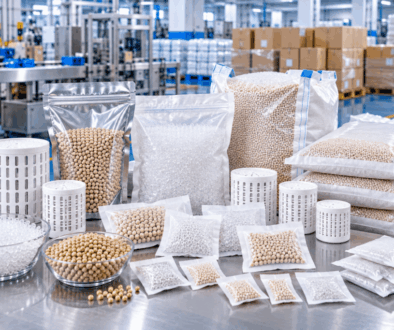
Bulk desiccants can be used directly in suitable applications or converted into different formats, including sachets, packets, canisters, pouches, and other moisture-control products.
The exact type of desiccant required depends on factors such as humidity level, product sensitivity, packaging design, storage conditions, transportation duration, and required moisture absorption capacity.
Why Are Bulk Desiccants Important?
Moisture can create several problems during product storage and transportation. Depending on the product, excessive humidity may contribute to corrosion, mold growth, clumping, degradation, loss of performance, or changes in physical properties.
A bulk desiccant manufacturer helps businesses address these challenges by supplying materials designed to absorb moisture from enclosed environments.
For example, pharmaceutical products may require controlled moisture conditions to maintain product stability. Electronics and metal components can be vulnerable to corrosion caused by humidity. Food and nutraceutical products may require protection against moisture-related changes in texture and quality.
By integrating suitable desiccants into packaging and storage systems, manufacturers can create an additional layer of moisture protection.
1. Major Types of Bulk Desiccants
Different products require different moisture-control approaches. A bulk desiccant manufacturer may offer several desiccant materials based on the intended application.
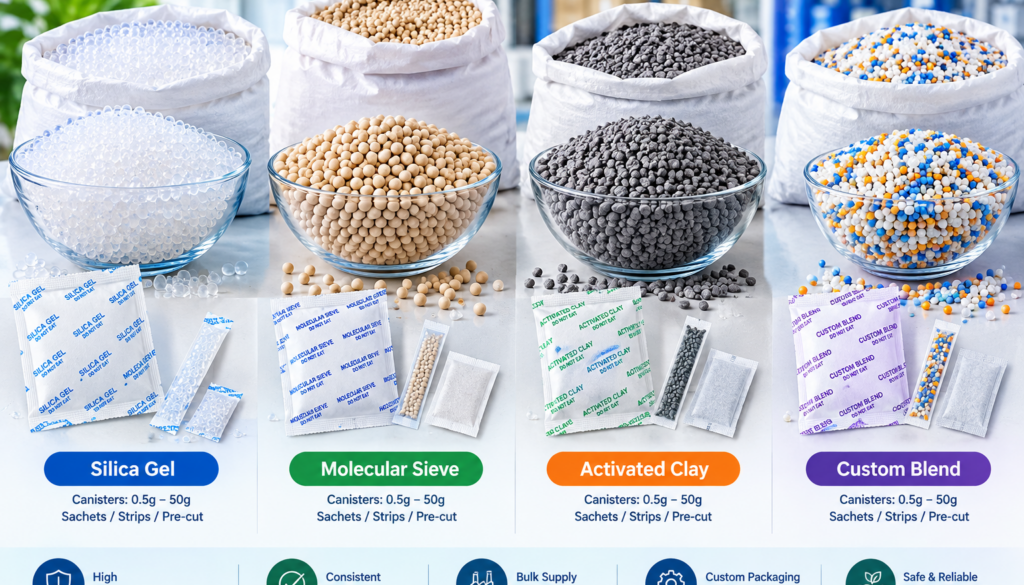
Silica Gel
Silica gel is one of the most widely used desiccant materials. It is a porous form of silicon dioxide with a large internal surface area that allows it to adsorb moisture.
Silica gel is commonly used in pharmaceutical packaging, food packaging, electronics, industrial products, leather goods, optical equipment, and general moisture-control applications.
Its versatility makes silica gel a popular choice for businesses looking for practical moisture protection.
Molecular Sieve
Molecular sieve desiccants are highly porous materials capable of adsorbing water molecules even under relatively low humidity conditions.
They are frequently used when stronger moisture control is required. Applications may include pharmaceuticals, chemicals, gases, electronics, laboratory products, and industrial processes.
A knowledgeable bulk desiccant manufacturer can help customers select an appropriate molecular sieve grade based on their moisture-control requirements.
Activated Clay
Clay-based desiccants are another option for moisture absorption. They can provide an economical solution for certain industrial and packaging applications.
Their performance depends on the material composition, environmental conditions, and packaging configuration. They are often considered for general-purpose moisture protection.
Other Moisture-Absorbing Materials
Depending on the industry and application, specialized moisture-control materials may also be available. The appropriate selection depends on factors such as required absorption capacity, temperature, humidity, product sensitivity, packaging volume, and regulatory requirements.
A professional bulk desiccant manufacturer can provide technical guidance to help businesses select an appropriate material.
Applications of Bulk Desiccants
Bulk desiccants are used across a wide range of industries because moisture can affect many different types of products.
1. Pharmaceutical Industry
Pharmaceutical products can be sensitive to humidity. Moisture may influence the physical and chemical stability of certain formulations, tablets, capsules, powders, and other products.
Desiccants are therefore commonly incorporated into pharmaceutical packaging to provide additional moisture protection.
A pharmaceutical-focused bulk desiccant manufacturer should understand the importance of consistent quality, suitable packaging materials, cleanliness, and applicable industry requirements.
2. Food and Nutraceutical Products
Food products, dietary supplements, nutraceuticals, and other moisture-sensitive products may experience quality changes when exposed to excess humidity.
Desiccants can help reduce moisture inside sealed packaging and support product protection during storage and transportation.
3. Electronics
Electronic components and devices may be sensitive to humidity and condensation. Moisture can contribute to corrosion and other forms of damage.
Bulk desiccant materials can be incorporated into packaging systems to help control humidity around moisture-sensitive electronic products.
4. Industrial Components
Metal parts, tools, machinery components, automotive parts, and precision equipment can be vulnerable to moisture and corrosion.
Using an appropriate desiccant as part of the packaging system can help provide additional protection during transportation and storage.
5. Chemicals
Certain chemicals and chemical products may be sensitive to moisture. In such applications, choosing the correct desiccant type and packaging configuration is particularly important.
A specialized bulk desiccant manufacturer can evaluate the application and recommend an appropriate moisture-control material.
6. Optical and Precision Products
Optical instruments, lenses, cameras, laboratory equipment, and precision components may require controlled storage conditions.
Moisture-control materials can help minimize humidity-related issues inside sealed packages.
Benefits of Working With a Bulk Desiccant Manufacturer
Purchasing directly from a bulk desiccant manufacturer can offer several advantages for businesses with regular or high-volume requirements.
Consistent Product Quality
Direct manufacturers generally have greater control over raw materials, production processes, quality checks, and packaging.
Consistent desiccant performance is important when the material is being used across large production volumes.
Bulk Supply Capability
Businesses with continuous production requirements need dependable supply. A capable bulk desiccant manufacturer should have sufficient production and packaging capacity to support regular orders.
Customized Solutions
Different products require different amounts and types of moisture protection. Manufacturers may be able to offer customized specifications, particle sizes, packaging formats, or quantities depending on the application.
Technical Support
Selecting a desiccant is not always as simple as choosing the highest absorption capacity. Environmental conditions, packaging volume, product characteristics, and storage duration all need to be considered.
An experienced manufacturer can help customers understand these requirements.
Better Supply Planning
Working directly with a manufacturer can make it easier for businesses to plan recurring orders, production schedules, packaging requirements, and inventory levels.
Bulk Desiccant Manufacturer vs. General Supplier
Businesses often have the option of purchasing desiccants from a distributor or directly from a bulk desiccant manufacturer.
A distributor can be useful for smaller quantities or immediate requirements. However, companies with regular high-volume requirements may benefit from working directly with a manufacturer.
Direct manufacturing relationships can provide better visibility into product specifications, production capabilities, quality systems, packaging options, and long-term supply planning.
The right choice ultimately depends on the company’s order volume, technical requirements, delivery expectations, and application.
How to Choose the Right Bulk Desiccant Manufacturer
Selecting a supplier requires more than simply comparing prices. Businesses should evaluate several factors before making a long-term purchasing decision.
Manufacturing Capability
Check whether the bulk desiccant manufacturer has sufficient production capacity to meet your current and future requirements.
A supplier should be able to maintain consistent production even when order volumes increase.
Product Range
Look for a manufacturer offering different desiccant options. A broad product range makes it easier to select the appropriate material for different applications.
Quality Control
Quality control is one of the most important considerations. Ask about raw material testing, production controls, moisture absorption testing, packaging inspection, and finished-product quality checks.
Packaging Options
Bulk desiccants may need to be repackaged into sachets, pouches, canisters, or other formats. Check whether the manufacturer can supply material in a format suitable for your production process.
Documentation
For regulated industries, documentation can be an important consideration. Depending on the application, customers may require specifications, test reports, certificates, or other quality documentation.
Production Consistency
A desiccant should provide consistent performance from batch to batch. Ask the bulk desiccant manufacturer about batch testing and quality-control procedures.
Delivery and Supply Reliability
A competitively priced product is not useful if it cannot be delivered when required. Evaluate manufacturing lead times, order planning, inventory availability, and logistics capabilities.
Key Factors to Consider Before Ordering Bulk Desiccants
Before placing a large order, businesses should clearly define their requirements.
| Factor | Why It Matters |
|---|---|
| Product type | Different materials require different moisture-control approaches |
| Packaging volume | Helps determine the required desiccant quantity |
| Humidity level | Influences desiccant selection and performance |
| Storage duration | Longer storage may require greater moisture protection |
| Transportation | Shipping conditions can affect moisture exposure |
| Product sensitivity | Highly sensitive products may require specialized desiccants |
| Desiccant type | Silica gel, molecular sieve, clay, or other materials may be considered |
| Packaging format | Determines how the desiccant will be incorporated |
| Order quantity | Helps with production and supply planning |
| Quality requirements | Important for consistent product performance |
Discussing these factors with a qualified bulk desiccant manufacturer can help businesses develop a more suitable moisture-control strategy.
How Bulk Desiccants Help During Storage and Transportation
Products may be exposed to changing environmental conditions while moving through warehouses, shipping facilities, trucks, containers, and distribution centers.
Temperature fluctuations can also contribute to condensation inside enclosed packaging. Once moisture becomes trapped inside a package, it may affect the product over time.
A suitable desiccant can help adsorb moisture within the enclosed packaging environment. This can provide an additional layer of protection during transportation and storage.
However, desiccants should be viewed as one part of a broader moisture-control strategy. Proper packaging design, sealing, storage conditions, and transportation practices are also important.
A reliable bulk desiccant manufacturer can help businesses understand how the desiccant should be selected and integrated into the overall packaging system.
Importance of Desiccant Quantity
Using too little desiccant may not provide adequate moisture protection, while using excessive amounts may increase packaging costs without providing additional practical benefits.
The required quantity depends on several factors, including:
- Internal package volume
- Expected humidity
- Product moisture content
- Packaging material
- Storage period
- Transportation conditions
- Required protection level
- Desiccant absorption capacity
Therefore, businesses should avoid selecting quantities based only on general recommendations. A bulk desiccant manufacturer or technical specialist can help assess the application and determine an appropriate approach.
Quality Considerations for Bulk Desiccant
Quality plays an important role when purchasing desiccants in bulk. Small differences in material quality or moisture content can influence overall performance.
A dependable bulk desiccant manufacturer should have controlled manufacturing processes and appropriate testing procedures.
Important quality considerations may include:
- Raw material consistency
- Moisture absorption capacity
- Particle or granule size
- Residual moisture
- Packaging integrity
- Batch consistency
- Storage conditions
- Product cleanliness
- Appropriate technical documentation
For industries with strict quality requirements, it is particularly important to select a supplier capable of maintaining consistent standards.
Bulk Desiccants for Different Industries
The requirements of a pharmaceutical company may be very different from those of an electronics manufacturer or industrial packaging company.
For example, pharmaceutical applications may prioritize controlled packaging and documentation, while industrial applications may focus on cost efficiency, absorption performance, and high-volume availability.
Similarly, electronics packaging may require moisture protection during long-distance transportation, while food applications may require packaging materials suitable for the intended product environment.
This is why choosing an experienced bulk desiccant manufacturer can be valuable. The supplier should understand that one desiccant solution may not be appropriate for every application.
Why Manufacturer Experience Matters
Experience can make a significant difference when selecting moisture-control materials.
An experienced bulk desiccant manufacturer is more likely to understand common challenges associated with different industries and packaging systems.
They may also be able to provide recommendations regarding:
- Desiccant selection
- Packaging formats
- Absorption requirements
- Storage conditions
- Bulk order planning
- Quality documentation
- Application-specific requirements
Rather than selecting a product only because it has a lower price, businesses should evaluate the overall value provided by the supplier.
Questions to Ask a Bulk Desiccant Manufacturer
Before finalizing a supplier, businesses can ask the following questions:
- What types of bulk desiccants do you manufacture?
- What industries do you supply?
- What desiccant grades are available?
- What are the typical moisture absorption specifications?
- Can you provide bulk quantities consistently?
- Are customized packaging options available?
- What quality-control procedures are followed?
- Can you provide product specifications and test documentation?
- What are the minimum order quantities?
- What are the typical production and delivery timelines?
- How should the desiccant be stored before use?
- Can you recommend a suitable product based on our application?
These questions can help businesses compare different suppliers more effectively.
Bulk Desiccant Storage and Handling
Even a high-quality desiccant can absorb moisture before it is used if it is not stored correctly.
Bulk desiccants should generally be kept in properly sealed packaging and protected from unnecessary exposure to ambient humidity.
Storage areas should be clean, dry, and suitable for the specific desiccant material. Once the packaging is opened, the material should be handled according to the manufacturer’s recommendations.
A professional bulk desiccant manufacturer can provide appropriate storage and handling guidance based on the product supplied.
Cost vs. Performance: What Should Businesses Consider?
Price is naturally an important factor when purchasing desiccants in bulk. However, the lowest purchase price does not always represent the lowest overall cost.
A lower-cost desiccant may provide different performance characteristics compared with a higher-quality material. If inadequate moisture protection results in damaged products, rejected batches, corrosion, or customer complaints, the overall cost can become much higher.
Businesses should therefore compare:
- Product quality
- Absorption performance
- Consistency
- Packaging
- Supply reliability
- Technical support
- Documentation
- Total cost of ownership
A reliable bulk desiccant manufacturer should provide a balance between product performance, quality, and commercial value.
Frequently Asked Question
What does a bulk desiccant manufacturer do?
A bulk desiccant manufacturer produces moisture-absorbing materials in larger quantities for industrial, commercial, packaging, pharmaceutical, food, electronics, and other applications.
Which desiccant is commonly used for moisture protection?
Silica gel is one of the most commonly used desiccants. Molecular sieve and clay-based desiccants are also used for specific applications.
Why buy desiccants in bulk?
Bulk purchasing can be suitable for businesses with regular production or packaging requirements. It can simplify supply planning and provide access to larger quantities for manufacturing operations.
How do I select a bulk desiccant manufacturer?
Consider manufacturing capacity, product quality, technical specifications, quality-control systems, documentation, packaging options, delivery reliability, and technical support.
Can bulk desiccants be customized?
Depending on the manufacturer, customization may be available for material type, particle size, quantity, packaging format, and other application requirements.
Are bulk desiccants suitable for pharmaceutical products?
Certain desiccants are commonly used in pharmaceutical packaging. However, the material and packaging configuration should be selected based on the specific product and applicable requirements.
How should bulk desiccants be stored?
Bulk desiccants should generally be kept sealed and protected from unnecessary exposure to humidity. Specific storage instructions should be obtained from the manufacturer.
Does every product require the same amount of desiccant?
No. The appropriate quantity depends on packaging volume, humidity, storage duration, product characteristics, packaging material, and other environmental factors.
Conclusion
Moisture control is an important consideration for businesses that manufacture, package, store, and transport moisture-sensitive products. The right desiccant can provide an additional layer of protection against humidity and help support product quality during storage and transportation.
Selecting a reliable bulk desiccant manufacturer is therefore an important part of developing an effective moisture-control strategy. Businesses should look beyond price and evaluate manufacturing capabilities, product quality, consistency, technical support, packaging options, documentation, and supply reliability.
Whether the requirement is for pharmaceuticals, nutraceuticals, food products, electronics, chemicals, industrial components, or other moisture-sensitive products, the appropriate desiccant should be selected according to the application’s specific requirements.
A dependable bulk desiccant manufacturer can help businesses identify suitable materials, plan bulk requirements, and establish a consistent supply for ongoing production needs. By choosing the right supplier and integrating desiccants with appropriate packaging and storage practices, companies can build a more reliable approach to moisture protection and product preservation.