Food Grade Desiccant Manufacturer: A Complete Guide to Moisture Protection for Food Packaging
Moisture is one of the most common challenges in food packaging and storage. Many food products can be affected by humidity during manufacturing, packaging, transportation, and storage. Excess moisture may cause products to lose their desired texture, develop clumps, become less stable, or experience other quality-related problems.
For manufacturers and food brands, choosing the right moisture-control solution is therefore an important part of packaging management. A reliable food grade desiccant manufacturer can provide desiccant solutions designed to help control moisture inside suitable food packaging environments.
Food-grade desiccants are moisture-absorbing materials used to reduce excess humidity within sealed packaging. Depending on the application, they can be supplied in sachets, pouches, canisters, or other suitable formats.
However, choosing a desiccant should not be based only on price. Product quality, packaging format, moisture adsorption capacity, documentation, manufacturing consistency, and application suitability are all important considerations.
This guide explains what food-grade desiccants are, how they work, where they are used, their benefits, and what businesses should consider when selecting a reliable food grade desiccant manufacturer.
What Is a Food Grade Desiccant?
A food-grade desiccant is a moisture-control material intended for use in appropriate food packaging applications. Its primary purpose is to adsorb moisture from the surrounding air and help maintain a more controlled environment inside sealed packaging.
Common desiccant materials may include:
- Silica gel
- Molecular sieve
- Clay-based desiccants
- Other application-specific moisture adsorbents
The appropriate material depends on the product, packaging design, expected humidity, storage conditions, and moisture-control requirements.
A professional food grade desiccant manufacturer can help businesses understand the available options and select a suitable product for their particular application.
Food packaging requirements can vary considerably. A dry snack, powdered food product, spice, nutritional product, or specialty ingredient may have different moisture sensitivities. Therefore, a single desiccant solution may not be appropriate for every product.
Why Moisture Control Matters in Food Packaging
Moisture can negatively affect many types of packaged food products.
Depending on the product formulation and packaging system, excess humidity may contribute to:
- Product clumping
- Texture changes
- Loss of crispness
- Reduced physical quality
- Packaging-related problems
- Unwanted deterioration
- Customer complaints
- Increased product wastage
For example, crispy snacks can lose their desired texture when exposed to moisture. Powdered products may form lumps, while certain dry ingredients can experience changes in their physical characteristics.
Effective moisture management can help reduce these risks.
A food grade desiccant manufacturer can provide suitable moisture-control products that work alongside the primary packaging system to help manage humidity.
It is important to understand that desiccants do not replace proper food packaging, hygiene practices, storage conditions, or quality-control procedures. Instead, they can form part of a broader moisture-management strategy.
How Does a Food Desiccant Work?
Desiccants work by removing or adsorbing water vapor from the surrounding environment.
When a food product is placed inside a sealed package, moisture may be present in the headspace. Moisture can also enter through packaging materials depending on their moisture-barrier properties.
A suitable desiccant can adsorb some of this water vapor and help maintain a lower relative humidity within the package.
The effectiveness of a desiccant depends on factors such as:
- Desiccant type
- Desiccant quantity
- Package volume
- Headspace
- Packaging barrier properties
- Product moisture content
- Storage conditions
- Temperature
- Expected distribution environment
For this reason, selecting the right product with support from a knowledgeable food grade desiccant manufacturer is important.
7 Benefits of Using Food Grade Desiccants
Food-grade desiccants can offer several advantages when appropriately selected and used.
1 Helps Control Moisture
The primary benefit is moisture adsorption. By reducing excess water vapor within suitable packaging, desiccants can help protect moisture-sensitive products.
2 Helps Maintain Product Quality
Moisture control can help products maintain their intended physical characteristics during storage and distribution.
3 Helps Reduce Clumping
Powdered and granular food products may be sensitive to humidity. Proper moisture control can help reduce unwanted clumping in suitable applications.
4 Helps Protect Texture
Products that depend on crispness or dryness can be negatively affected by humidity. Appropriate desiccant solutions can support better moisture management.
5 Flexible Packaging Formats
Food desiccants can be supplied in different formats depending on the packaging requirements.
6 Convenient for Packaging Operations
Sachets, pouches, and canisters can often be incorporated into suitable packaging processes.
7 Supports Better Storage Conditions
Moisture control can be particularly valuable during transportation and storage where environmental humidity may fluctuate.
These benefits make food-grade desiccants an important consideration for many moisture-sensitive food packaging applications.
Applications of Food Grade Desiccants
A food grade desiccant can be considered for a variety of dry and moisture-sensitive products.
Potential applications include:
- Dry snacks
- Crackers
- Biscuits
- Dried fruits
- Spices
- Seasonings
- Powdered ingredients
- Dry mixes
- Bakery ingredients
- Nutritional products
- Specialty food ingredients
- Dehydrated food products
- Seeds and certain food-related products
- Pet food applications where appropriate
The exact suitability depends on the product and packaging system.
A professional food grade desiccant manufacturer can evaluate the application and recommend an appropriate desiccant format and capacity.
Food Grade Silica Gel for Packaging
Silica gel is one of the most widely recognized desiccant materials used for moisture control.
It has a porous structure that provides a large surface area for water-vapor adsorption. Because of its moisture-adsorption properties and flexible packaging options, silica gel can be used in many dry-product packaging applications.
Silica gel may be supplied as:
- Sachets
- Pouches
- Canisters
- Packets
- Custom-sized formats
The correct format depends on the package design and product requirements.
When selecting a food grade desiccant manufacturer, businesses should ask about the type of silica gel offered, available packaging materials, product specifications, and quality documentation.
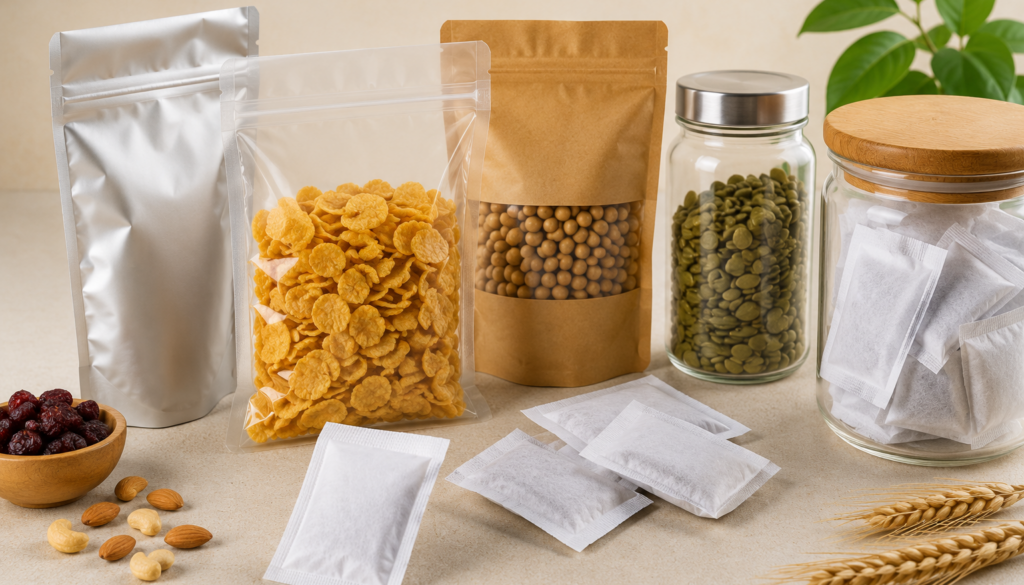
Food Grade Desiccant Sachets
Desiccant sachets are a convenient moisture-control format for many packaged products.
They are compact and can be placed inside suitable containers, boxes, or sealed packages.
Depending on the application, sachets may be available in different:
- Sizes
- Fill weights
- Packaging materials
- Printing options
- Shapes
- Configurations
Customized sachets may also be available for businesses with specific packaging requirements.
A reliable food grade desiccant manufacturer can discuss the appropriate sachet size and material based on the intended application.
Food Grade Desiccant Canisters
Canisters are another moisture-control option.
Their rigid structure can make them convenient for certain packaging applications, particularly products packed in bottles or rigid containers.
Canisters can offer practical handling and placement advantages depending on the packaging design.
Before choosing a canister, manufacturers should consider:
- Container size
- Product type
- Headspace
- Moisture sensitivity
- Storage conditions
- Required moisture capacity
- Packaging process
A knowledgeable food grade desiccant manufacturer can help determine whether sachets, canisters, or another format is more appropriate.
How to Choose a Reliable Food Grade Desiccant Manufacturer
Choosing a reliable manufacturer is an important purchasing decision.
Businesses should evaluate several factors rather than focusing only on cost.
1 Manufacturing Quality
The manufacturer should maintain consistent production and quality-control procedures.
Consistent manufacturing helps businesses receive predictable products across different batches.
2 Product Specifications
Ask for clear product specifications, including available sizes, fill weights, materials, and relevant technical information.
3 Quality Documentation
Depending on the application and market requirements, manufacturers may need appropriate quality and technical documentation.
Ask what documentation is available before placing a large order.
4 Production Capacity
A supplier should have sufficient manufacturing capacity to support your current and future requirements.
5 Packaging Options
Different food products require different packaging formats. A manufacturer offering multiple options can provide greater flexibility.
6 Customization
Some businesses may require customized sachet sizes, printing, labeling, packaging materials, or private-label solutions.
7 Reliable Delivery
Consistent supply is important because packaging operations may depend on continuous availability of desiccants.
8 Technical Support
A strong manufacturer should be able to discuss your application and provide practical guidance on product selection.
Why the Lowest Price Is Not Always the Best Choice
Price is an important consideration, but it should not be the only deciding factor.
Choosing a low-cost product without evaluating quality, consistency, documentation, and supply reliability can create negative consequences later.
Potential problems may include:
- Inconsistent product performance
- Packaging issues
- Supply delays
- Limited customization
- Poor technical support
- Additional procurement costs
- Production interruptions
A dependable food grade desiccant manufacturer should offer a balance of quality, performance, service, and competitive pricing.
The goal should be to achieve the best overall value rather than simply selecting the lowest quotation.
Factors That Determine the Required Desiccant Quantity
There is no universal desiccant quantity that works for every food package.
The required quantity can depend on:
- Package size
- Headspace
- Product moisture content
- Product sensitivity
- Packaging material
- Moisture-barrier properties
- Storage conditions
- Distribution conditions
- Expected shelf life
- Environmental humidity
Using insufficient desiccant may provide inadequate moisture control, while using excessive desiccant may increase costs unnecessarily.
A professional food grade desiccant manufacturer can help evaluate these factors and recommend a suitable configuration.
Manufacturers should avoid selecting desiccant quantities solely by copying another product’s packaging specification.
Food Packaging and Desiccant Selection
Desiccants work as part of the complete packaging system.
The primary packaging must provide an appropriate barrier against external moisture. The desiccant then helps manage moisture within the package.
Therefore, manufacturers should consider:
- Packaging material
- Seal integrity
- Container closure
- Headspace
- Desiccant capacity
- Product moisture sensitivity
- Storage environment
A strong packaging strategy combines suitable packaging materials with appropriate moisture-control solutions.
Working with an experienced food grade desiccant manufacturer can help businesses better understand how the desiccant fits into the overall packaging design.
Food Grade Desiccants for Dry Food Products
Dry food products can be particularly sensitive to humidity.
Examples include crackers, dry mixes, spices, dehydrated ingredients, and certain snack products.
When moisture enters the package, the product may lose its desired physical characteristics.
For instance, a crisp product may become less crisp, while a powdered product may develop unwanted lumps.
A suitable desiccant can help manage moisture inside the package and support better product quality.
However, manufacturers should evaluate each application individually because the moisture requirements of different food products can vary significantly.
Quality Considerations When Buying Food Desiccants
Quality should remain a top priority when sourcing desiccants for food packaging.
Before selecting a food grade desiccant manufacturer, businesses should evaluate:
- Raw material quality
- Manufacturing processes
- Quality-control procedures
- Product consistency
- Packaging integrity
- Available documentation
- Storage conditions
- Batch traceability where applicable
- Customer support
The supplier should be transparent about the product being supplied and its intended application.
Businesses should also communicate their specific requirements clearly to avoid selecting an unsuitable product.
6 Common Mistakes to Avoid
Mistake 1: Selecting Only by Price
Low pricing may appear attractive, but product quality and consistency are equally important.
Mistake 2: Using an Incorrect Desiccant Quantity
Too little or too much desiccant may not provide the desired balance between moisture control and packaging cost.
Mistake 3: Ignoring Packaging Barrier Properties
A desiccant cannot compensate for an unsuitable packaging system.
Mistake 4: Not Checking Product Documentation
Businesses should understand what technical and quality documentation is available before purchasing.
Mistake 5: Choosing a Supplier Without Evaluating Capacity
A manufacturer should be able to support the required volume and delivery schedule.
Mistake 6: Treating Every Food Product the Same
Different products have different moisture sensitivities. The desiccant solution should be application-specific.
Avoiding these mistakes can make the procurement process more efficient and reliable.
Food Grade Desiccant Manufacturer for Bulk Requirements
Large food manufacturers may require regular and high-volume desiccant supplies.
For such businesses, supplier capacity becomes particularly important.
A reliable manufacturer should be able to support:
- Bulk orders
- Recurring requirements
- Consistent product quality
- Production planning
- Customized packaging
- Scheduled deliveries
- Long-term supply arrangements
Long-term cooperation can also help businesses improve procurement planning and reduce the risk of unexpected shortages.
When evaluating a food grade desiccant manufacturer, ask about production capacity, standard lead times, minimum order quantities, and recurring supply capabilities.
Customized Food Grade Desiccant Solutions
Food brands may have packaging requirements that are different from standard products.
Customization can help businesses select a desiccant format that fits their packaging process.
Depending on the manufacturer, customized solutions may include:
- Sachet size
- Fill quantity
- Packaging material
- Printing
- Labeling
- Branding
- Canister size
- Bulk packaging
- Private-label manufacturing
Customization can be particularly useful for businesses with large production volumes or specialized packaging requirements.
A professional food grade desiccant manufacturer can discuss available customization options according to the customer’s requirements.
Why Manufacturer Experience Matters
Experience can be valuable when choosing a desiccant manufacturing partner.
An experienced manufacturer may have knowledge of different packaging formats, product applications, manufacturing requirements, and moisture-control challenges.
This can help businesses avoid common mistakes and identify a more suitable solution.
However, experience should be evaluated together with actual manufacturing capabilities, product consistency, documentation, customer service, and supply reliability.
A good manufacturer should provide practical information rather than making unsupported claims.
Questions to Ask a Food Grade Desiccant Manufacturer
Before finalizing a supplier, ask the following questions:
- What types of food-grade desiccants do you manufacture?
- What desiccant materials are available?
- What sachet sizes and fill weights do you offer?
- Are customized sizes available?
- What packaging materials can you provide?
- What quality documentation is available?
- Can you support bulk orders?
- What is your production capacity?
- What are your standard lead times?
- Do you offer private-label manufacturing?
- Can you provide technical assistance?
- Can you help determine the appropriate desiccant quantity?
- Can you support recurring supply requirements?
- What quality-control procedures are followed?
These questions can help businesses compare manufacturers more effectively.
Food Grade Desiccants vs. Other Moisture-Control Solutions
Desiccants are one of several approaches to moisture management.
Depending on the application, businesses may also consider:
- Moisture-barrier packaging
- Improved sealing systems
- Controlled storage environments
- Humidity-control systems
- Other desiccant materials
The most effective approach depends on the product and packaging system.
For some applications, silica gel may be suitable. For others, molecular sieve or another desiccant may provide different moisture-control characteristics.
A knowledgeable food grade desiccant manufacturer can help businesses evaluate the available options according to their requirements.
Benefits of Working Directly With a Manufacturer
Buying directly from a manufacturer can offer several potential advantages.
These may include:
- Better communication
- More customization options
- Direct technical support
- Greater supply visibility
- Bulk-order capabilities
- Product consistency
- Easier quality discussions
- Long-term supply planning
Direct communication can also make it easier to explain specific packaging requirements and receive appropriate recommendations.
For businesses with regular requirements, establishing a long-term relationship with a reliable food grade desiccant manufacturer can simplify procurement.
Supporting Better Food Packaging Performance
Moisture control is an important part of protecting many dry food products.
A suitable desiccant can support packaging performance by helping manage water vapor inside the sealed environment.
When combined with suitable packaging materials, proper sealing, controlled storage, and good manufacturing practices, moisture-control solutions can contribute to a more reliable packaging system.
The key is to select the right product for the application.
A professional food grade desiccant manufacturer can help businesses make more informed decisions regarding material, format, capacity, and packaging requirements.
Frequently Asked Questions
1. What is a food grade desiccant manufacturer?
A food grade desiccant manufacturer produces moisture-control products intended for suitable food packaging applications. These may include silica gel sachets, desiccant pouches, canisters, and other moisture-absorbing solutions.
2. Why are desiccants used in food packaging?
Desiccants are used to adsorb moisture from the air inside suitable sealed packages. This can help reduce humidity-related problems such as clumping, texture changes, and loss of crispness in moisture-sensitive products.
3. Which desiccant is commonly used for food packaging?
Silica gel is a commonly used desiccant for various moisture-control applications. Other materials, such as molecular sieve and clay-based desiccants, may also be considered depending on the application.
4. Can silica gel be used in food packaging?
Appropriately specified silica gel desiccant products can be used in suitable food packaging applications. The product, packaging format, and intended use should be evaluated carefully before selection.
5. How do I choose the right food grade desiccant manufacturer?
Consider product quality, manufacturing capacity, documentation, packaging options, customization, technical support, delivery reliability, and experience with the intended application.
6. Can food-grade desiccants be customized?
Depending on the manufacturer, customization may include sachet size, fill weight, packaging material, printing, labeling, branding, and other packaging requirements.
7. How much desiccant is required for food packaging?
The required quantity depends on package volume, headspace, product moisture sensitivity, packaging material, storage conditions, and other application factors. There is no universal quantity for every product.
8. Are desiccant sachets suitable for dry food products?
Desiccant sachets can be considered for many suitable dry food applications. The correct sachet material, size, and quantity should be selected based on the specific packaging requirements.
9. Can a manufacturer supply desiccants in bulk?
Many manufacturers support bulk and recurring requirements. Businesses should confirm production capacity, minimum order quantities, lead times, and delivery schedules before placing an order.
10. Why is moisture control important for food products?
Excess moisture can negatively affect the physical characteristics and quality of many food products. Appropriate moisture management can help reduce these risks and support better storage stability.
Conclusion
Moisture management is an important consideration for manufacturers and brands producing moisture-sensitive food products. Excess humidity can contribute to unwanted changes such as clumping, loss of crispness, texture changes, and other quality concerns.
Using an appropriate desiccant can help manage moisture inside suitable sealed packaging.
Choosing the right food grade desiccant manufacturer is therefore an important part of developing an effective moisture-control strategy. Businesses should evaluate product quality, manufacturing consistency, documentation, packaging formats, customization options, production capacity, technical support, and supply reliability before selecting a supplier.
The best solution is not necessarily the cheapest product. Instead, manufacturers should look for a dependable partner that can provide consistent quality and suitable solutions for their specific packaging requirements.
Whether you need silica gel sachets, desiccant pouches, canisters, or customized moisture-control solutions, selecting an experienced food grade desiccant manufacturer can help simplify procurement and support better packaging performance.
By combining appropriate desiccant technology with suitable packaging materials, proper sealing, controlled storage, and good quality practices, food manufacturers can build a stronger approach to moisture protection.
If you are looking for a food grade desiccant manufacturer, evaluate your product and packaging requirements first, compare qualified manufacturers, request technical information, and select a supplier capable of providing consistent quality and dependable long-term support.