Moisture Control for Tablets and Capsules: A Complete Guide to Protecting Pharmaceutical Products
Moisture control for tablets and capsules is an essential part of pharmaceutical and nutraceutical packaging. Humidity can affect the physical appearance, stability, strength, dissolution, and shelf life of moisture-sensitive products. Therefore, manufacturers need reliable packaging solutions that help protect tablets and capsules from unwanted moisture throughout manufacturing, storage, transportation, and distribution.
Tablets and capsules may contain active pharmaceutical ingredients, vitamins, minerals, herbal extracts, probiotics, enzymes, and other sensitive ingredients. Some of these ingredients can absorb moisture from the surrounding environment. As a result, excessive humidity may cause tablets to soften, become sticky, crack, swell, discolour, or lose their physical integrity. Capsules can also experience changes in their shell properties when exposed to unsuitable humidity levels.
An effective moisture-control strategy can help minimise these risks. Desiccants such as silica gel and molecular sieve are commonly used to reduce moisture inside sealed pharmaceutical packaging. When the right desiccant is combined with suitable moisture-barrier packaging, proper sealing, and appropriate storage conditions, manufacturers can create a more controlled environment for sensitive products.
Why Moisture Control for Tablets and Capsules Is Important
Pharmaceutical products are expected to maintain their quality and performance throughout their intended shelf life. However, moisture can become a significant packaging challenge if it is not properly managed.
Water vapour can enter a container through the air trapped inside the package, packaging materials, closures, seals, and other pathways. Once moisture is present inside the package, it may interact with the formulation and affect product quality.
For example, certain tablets may absorb moisture and become softer or more fragile. Other formulations may experience changes in dissolution or disintegration characteristics. In addition, moisture can contribute to chemical degradation in formulations that contain moisture-sensitive ingredients.
Capsules also require careful humidity management. Depending on their composition, excessive humidity can affect shell texture, flexibility, handling, and appearance. On the other hand, extremely dry conditions may also create challenges for certain capsule materials.
Therefore, manufacturers should consider humidity protection during the early stages of packaging development. Effective moisture control for tablets and capsules should be designed according to the formulation, container, storage conditions, transportation environment, and expected shelf life.
How Moisture Affects Tablets and Capsules
The effect of moisture depends on the formulation and the sensitivity of the ingredients.
Tablets may absorb water vapour from the surrounding environment. This can influence hardness, friability, disintegration, dissolution, and physical appearance. In some cases, tablets may become sticky and difficult to handle or may develop cracks and surface defects.
Moisture can also affect the stability of certain active ingredients and excipients. Chemical reactions may occur more rapidly when moisture is present, potentially affecting the long-term quality of a sensitive formulation.
Capsules may respond differently because their shells can interact with environmental humidity. Excess moisture may make some capsules softer or more prone to sticking, while insufficient moisture may contribute to brittleness.
Because different products behave differently, manufacturers should not use the same moisture-protection approach for every tablet or capsule. Instead, the packaging system should be evaluated according to the specific product requirements.
This is why moisture control for tablets and capsules should be treated as a complete packaging strategy rather than simply adding a desiccant to a bottle.
Common Sources of Moisture Exposure
Moisture can enter pharmaceutical packaging from several sources.
The first source is the air inside the container. When a bottle or container is sealed, the air in the headspace contains a certain amount of water vapour.
The second source is the packaging material. Different plastics, films, liners, closures, and seals have different moisture-barrier properties. Depending on the packaging design and environmental conditions, water vapour may gradually pass through the packaging system.
The third source is the manufacturing environment. Tablets and capsules may be exposed to humidity before they are placed into their final containers. If the production environment is not properly controlled, the product may already contain additional moisture before packaging.
Transportation can create another challenge. Products may move through warehouses, trucks, shipping containers, and distribution centres where temperature and humidity conditions vary.
International shipments can be particularly demanding because products may pass through multiple climate zones. Consequently, manufacturers should consider the entire supply chain when developing moisture control for tablets and capsules.
Role of Desiccants in Pharmaceutical Packaging
Desiccants are materials designed to remove or hold moisture from an enclosed environment. They are widely used in pharmaceutical, nutraceutical, food, electronics, and industrial packaging.
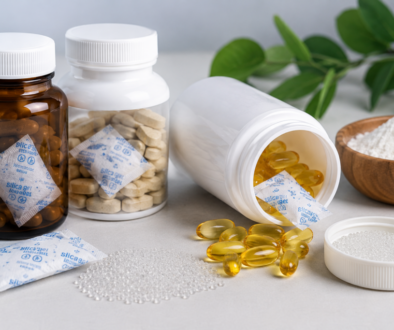
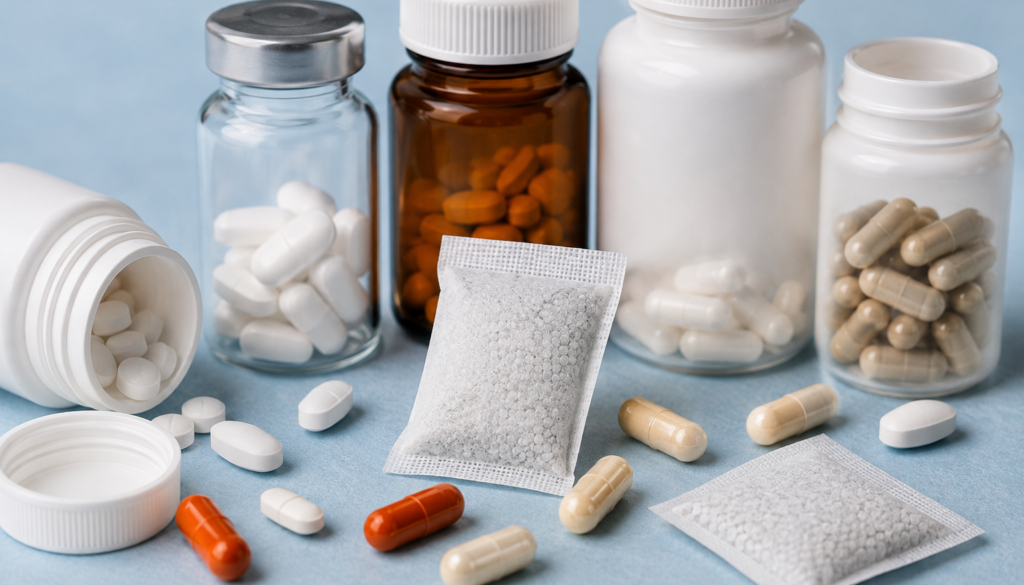
In pharmaceutical packaging, desiccants are commonly available in sachet and canister formats. They can be placed inside suitable containers to help reduce humidity around moisture-sensitive products.
Silica gel is one of the most widely used desiccants because of its moisture-adsorption properties. Molecular sieve is another option and may be considered when stronger moisture adsorption or lower humidity conditions are required.
The correct desiccant depends on several factors. These include product moisture sensitivity, container volume, packaging barrier, headspace, storage conditions, transportation conditions, and required shelf life.
A desiccant should not be selected simply because it is commonly used. Instead, manufacturers should evaluate the complete packaging system and choose a solution that matches the application’s requirements.
Silica Gel for Tablets and Capsules
Silica gel is a popular choice for moisture control for tablets and capsules because it can effectively adsorb water vapour within a sealed package.
Its porous structure provides a large surface area for moisture adsorption. This allows silica gel to help maintain a drier environment inside suitable pharmaceutical containers.
Silica gel can be supplied in different sizes, grades, capacities, and packaging formats. Sachets are commonly used in bottles containing tablets, capsules, vitamins, and dietary supplements. Canisters can also be used where a rigid format is more suitable for the packaging design.
The amount of silica gel required depends on the application. A small container with a relatively stable formulation may require a different desiccant capacity from a larger container holding highly moisture-sensitive capsules.
Manufacturers should also protect unused silica gel from unnecessary exposure to ambient humidity. If the desiccant absorbs moisture before it is placed inside the final package, its available capacity may be reduced.
Molecular Sieve for Strong Moisture Protection
Molecular sieve is another desiccant option used in applications that require effective humidity management.
Its controlled pore structure allows it to adsorb water molecules efficiently. Because of this characteristic, molecular sieve may be suitable for products that require stronger moisture protection or lower internal humidity.
The choice between silica gel and molecular sieve depends on the product and packaging requirements. Manufacturers should consider formulation sensitivity, packaging material, container size, expected environmental conditions, and shelf-life requirements.
For highly moisture-sensitive products, technical evaluation can help determine whether molecular sieve provides an appropriate advantage over other desiccant materials.
How to Choose the Right Desiccant
Selecting the correct desiccant is one of the most important steps in moisture control for tablets and capsules.
Product sensitivity: Determine how strongly the formulation responds to humidity. Highly sensitive products may require stronger moisture protection.
Container volume: The size of the container affects the amount of moisture present in the internal headspace.
Packaging barrier: Evaluate the moisture resistance of the bottle, closure, liner, blister, pouch, or other packaging components.
Storage environment: Temperature and humidity conditions during storage can influence the required desiccant capacity.
Transportation: Long-distance or international transportation may expose products to changing environmental conditions.
Shelf life: Products with longer shelf-life requirements may require a carefully evaluated moisture-control system.
Desiccant format: Sachets and canisters have different physical characteristics and may suit different packaging processes.
Manufacturing process: The selected desiccant should be compatible with manual or automated filling and packaging operations.
By considering these factors together, manufacturers can develop a more reliable approach to moisture protection.
Desiccant Sachets and Desiccant Canisters
Desiccant sachets and canisters are two commonly used formats for pharmaceutical packaging.
Sachets are flexible and can be produced in different sizes and capacities. They are convenient for many tablet, capsule, vitamin, and nutraceutical bottles.
Canisters are rigid and compact. Their structure can make them suitable for certain bottle designs and automated packaging systems.
Neither format is universally better. The appropriate choice depends on the container design, available space, manufacturing process, product requirements, and handling conditions.
Both formats can support moisture control for tablets and capsules when the correct product and capacity are selected for the application.
Importance of Moisture-Barrier Packaging
A desiccant is only one component of a complete moisture-protection strategy.
The packaging container should also provide an appropriate moisture barrier. If moisture continuously enters through the packaging system, the desiccant may become saturated faster than expected.
Manufacturers should therefore evaluate the container, closure, liner, seal, and packaging material as a complete system.
Glass containers can provide strong barrier properties, while different polymer materials provide different levels of moisture resistance. Blister packs and specialised barrier films may also be used for moisture-sensitive products.
Combining suitable moisture-barrier packaging with an appropriately selected desiccant can provide more reliable moisture control for tablets and capsules.
Moisture Control for Pharmaceutical and Nutraceutical Products
Moisture protection is important for both pharmaceutical and nutraceutical products.
Vitamin tablets, mineral supplements, herbal capsules, botanical products, probiotics, enzymes, and other dietary supplements may contain ingredients that are sensitive to humidity.
Moisture may affect the physical texture, appearance, stability, flow properties, and shelf life of these products. Consequently, manufacturers should evaluate moisture protection during product and packaging development.
For nutraceutical companies, reliable moisture-control solutions can help protect products throughout storage and distribution. This is particularly useful when products are shipped through warm or humid environments.
Best Practices for Effective Moisture Control
Manufacturers can follow several practices to improve packaging protection.
First, evaluate the moisture sensitivity of the formulation before selecting the packaging system.
Second, choose packaging materials with appropriate moisture-barrier properties.
Third, determine the suitable desiccant type and capacity based on the complete package.
Fourth, protect unused desiccants from ambient humidity before they are used.
Fifth, ensure that the desiccant is correctly inserted during the packaging process.
Sixth, maintain suitable sealing and closure integrity to reduce moisture entry.
Finally, consider stability and packaging evaluations to confirm that the selected system provides the required protection.
These practices can make moisture control for tablets and capsules more consistent and reliable.
Common Moisture-Control Mistakes to Avoid
Several common mistakes can reduce the effectiveness of a moisture-control system.
One mistake is selecting a desiccant only according to container size. Product sensitivity and environmental conditions should also be considered.
Another mistake is using insufficient desiccant capacity for demanding storage or transportation conditions.
Manufacturers should also avoid leaving unused desiccants exposed to humid air for long periods. Proper storage helps maintain desiccant performance.
Poor container sealing is another potential problem. Even an effective desiccant may not provide sufficient protection if moisture continuously enters through an inadequate closure system.
Finally, manufacturers should avoid using the same desiccant configuration for every product. Different formulations and packaging systems require different moisture-control strategies.
How to Choose a Reliable Desiccant Manufacturer
Choosing the right supplier is an important part of developing effective moisture control for tablets and capsules.
Manufacturers should evaluate product consistency, available desiccant formats, technical support, manufacturing capacity, packaging options, documentation, and supply reliability.
A reliable supplier should understand the requirements of pharmaceutical and nutraceutical packaging. They should be able to provide suitable options for different container sizes, moisture sensitivities, and production processes.
Businesses should also consider long-term supply requirements. Consistent product quality and dependable availability are important for manufacturers operating continuous production lines.
Working with an experienced desiccant manufacturer can make product selection easier and help businesses develop a more suitable packaging strategy.
Why Choose Moistop for Moisture Control Solutions
Moistop provides moisture-control and desiccant solutions for businesses that require protection against humidity.
The company offers different desiccant formats and moisture-control products suitable for a range of packaging applications. These solutions can be considered by pharmaceutical, nutraceutical, packaging, and other moisture-sensitive product manufacturers.
Moistop’s product range includes solutions such as silica gel desiccants, desiccant sachets, desiccant canisters, molecular sieve desiccants, and other moisture-control products.
For manufacturers handling moisture-sensitive tablets, capsules, supplements, and related products, selecting the right desiccant can provide an additional layer of protection inside the final package.
The most suitable product depends on the application. Therefore, manufacturers should consider product sensitivity, container design, storage environment, transportation conditions, and shelf-life requirements before finalising the desiccant solution.
10 Frequently Asked Questions About Moisture Control for Tablets and Capsules
1. Why is moisture control important for tablets and capsules?
Moisture control helps protect tablets and capsules from humidity that may affect physical properties, stability, appearance, and shelf life. The required level of protection depends on the formulation and packaging system.
2. Which desiccant is commonly used for tablets and capsules?
Silica gel is widely used for pharmaceutical packaging. Molecular sieve may also be considered for applications requiring stronger moisture adsorption or lower humidity conditions.
3. Can silica gel be used with pharmaceutical capsules?
Yes. Appropriately selected silica gel sachets or canisters can be used for suitable capsule packaging applications. The correct size and capacity should be determined according to the product and packaging requirements.
4. What is the difference between silica gel and molecular sieve?
Both materials are used for moisture adsorption, but they have different characteristics. Silica gel is widely used for general moisture-control applications, while molecular sieve can provide strong adsorption at relatively low humidity levels.
5. How much desiccant is required for a tablet bottle?
There is no universal quantity. The appropriate amount depends on container volume, product sensitivity, packaging barrier, storage conditions, transportation conditions, and shelf-life requirements.
6. Are desiccant sachets suitable for pharmaceutical packaging?
Yes. Desiccant sachets are commonly used in suitable pharmaceutical and nutraceutical packaging applications. They are available in different sizes and capacities.
7. Are desiccant canisters better than sachets?
Not necessarily. The right format depends on the container design, available space, manufacturing process, and product requirements.
8. Can a desiccant replace moisture-barrier packaging?
No. A desiccant should work together with suitable moisture-barrier packaging and proper sealing. The complete packaging system should be evaluated for the intended application.
9. Why should unused desiccants be stored properly?
Desiccants can absorb moisture from ambient air before use. Proper storage helps preserve their available moisture-adsorption capacity until they are inserted into the final package.
10. How can manufacturers improve moisture control for tablets and capsules?
Manufacturers should evaluate product moisture sensitivity, packaging materials, container size, storage conditions, transportation requirements, and shelf life. Selecting an appropriate desiccant and maintaining proper packaging integrity can improve moisture protection.
Conclusion
Moisture control for tablets and capsules is an important part of pharmaceutical and nutraceutical packaging. Uncontrolled humidity can affect product appearance, physical properties, stability, and shelf life. Therefore, manufacturers should consider moisture protection from the beginning of product and packaging development.
Silica gel and molecular sieve are useful desiccant options for managing humidity inside suitable sealed packages. However, the best results come from combining the appropriate desiccant with suitable moisture-barrier packaging, reliable sealing, correct storage, and proper handling procedures.
There is no single desiccant solution that is suitable for every tablet or capsule. Product formulation, container size, packaging material, environmental conditions, transportation requirements, and shelf life all influence the final selection.
By choosing an appropriate moisture-control strategy and working with a reliable desiccant manufacturer, pharmaceutical and nutraceutical businesses can better protect their products throughout the supply chain.
Moistop provides moisture-control solutions designed for different packaging applications. Businesses can evaluate suitable silica gel, molecular sieve, sachet, and canister solutions according to their specific requirements.
When product quality and shelf life matter, effective moisture protection should not be overlooked. A well-planned moisture-control system can provide valuable protection and support consistent product quality from manufacturing through final use.