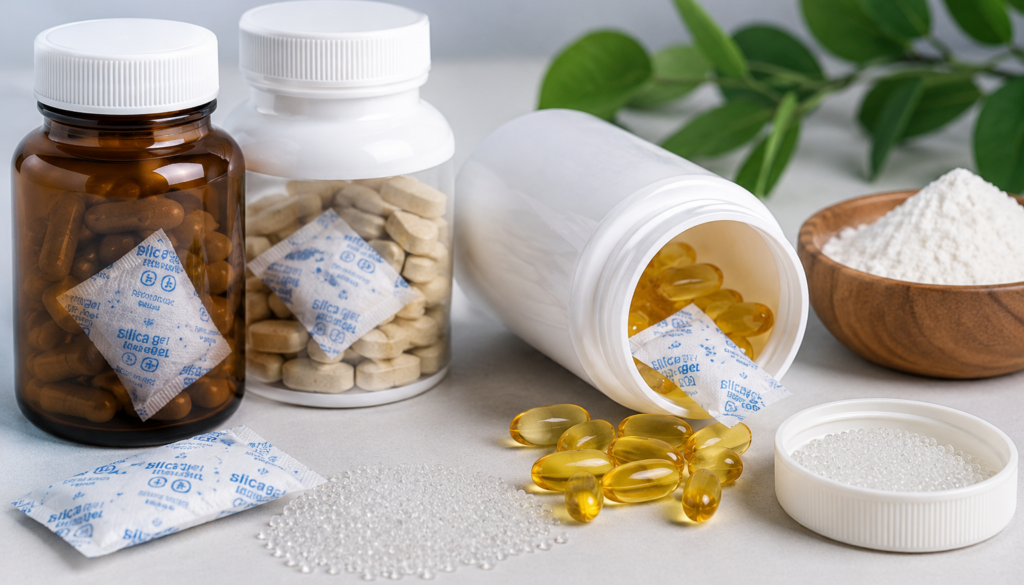
Silica Gel Supplier for Nutraceuticals: A Complete Guide to Safe Moisture Protection
Moisture is one of the biggest challenges faced by the nutraceutical industry. Tablets, capsules, powders, vitamins, minerals, herbal supplements, probiotics, and other nutraceutical products can be negatively affected when exposed to excessive humidity. Moisture can lead to product deterioration, changes in texture, reduced stability, clumping, unpleasant odors, and other quality problems.
This is why choosing the right silica gel supplier for nutraceuticals is an important decision for manufacturers, contract packers, distributors, and supplement brands.
Silica gel is a highly effective desiccant used to control moisture inside sealed packaging. It works by adsorbing moisture from the surrounding air and helping maintain a drier environment inside the package. When correctly selected and appropriately packaged, silica gel can provide an effective moisture-control solution for a wide range of nutraceutical products.
However, not every supplier offers the same level of product quality, consistency, packaging options, documentation, and technical support. A reliable silica gel supplier for nutraceuticals should understand the specific requirements of the nutraceutical and supplement industry and provide solutions that match the product and packaging requirements.
This guide explains how silica gel works, why it is important for nutraceutical packaging, what to look for in a supplier, and how businesses can choose a reliable moisture-control partner.
2. Why Moisture Control Is Important for Nutraceutical Products
Nutraceutical products often contain ingredients that can be sensitive to humidity. Depending on the formulation, moisture exposure may negatively affect physical appearance, stability, packaging performance, and overall product quality.
For example, certain tablets may become soft or sticky when exposed to excessive moisture. Powders can absorb humidity and develop unwanted clumps. Capsules may also experience changes in physical characteristics under unsuitable storage conditions.
These problems can create several negative consequences for manufacturers:
- Reduced product quality
- Poor appearance
- Unwanted clumping
- Packaging complaints
- Increased product wastage
- Reduced customer satisfaction
- Potential storage difficulties
- Additional quality-control concerns
Using an appropriate desiccant can help reduce these moisture-related risks.
A professional silica gel supplier for nutraceuticals can help businesses select the right desiccant format and quantity based on the product type, package size, expected humidity exposure, and intended shelf-life requirements.
3. What Is Silica Gel?
Silica gel is a porous form of silicon dioxide that is widely used as a desiccant. Despite its name, silica gel is a solid material rather than a liquid gel.
Its highly porous structure provides a large surface area for adsorbing water vapor from the surrounding environment. This makes silica gel an effective option for moisture control in many types of packaging.
Silica gel is available in different forms, including:
- Silica gel sachets
- Silica gel canisters
- Loose silica gel
- Different particle sizes
- Different packaging materials
- Different moisture adsorption capacities
For nutraceutical applications, the selection should be based on the packaging environment and application requirements rather than simply choosing the cheapest available product.
A knowledgeable silica gel supplier for nutraceuticals can recommend a suitable format according to the product and packaging system.
4. How Silica Gel Protects Nutraceutical Packaging
The main function of silica gel is moisture adsorption.
When a nutraceutical product is packed inside a sealed container, a certain amount of moisture may already be present in the headspace. Additional moisture can also enter through the packaging material depending on its moisture-barrier properties.
Silica gel helps adsorb water vapor from this environment.
This can create several positive benefits:
- Better moisture control
- Improved product protection
- Reduced humidity-related quality issues
- Better physical appearance
- Lower risk of clumping
- Improved packaging conditions
- More consistent product quality
The desiccant does not replace proper packaging, storage, or quality-control practices. Instead, it works as an additional moisture-control component within the overall packaging system.
Therefore, working with an experienced silica gel supplier for nutraceuticals can help manufacturers develop a more reliable moisture-management strategy.
5. Why Choose a Specialized Silica Gel Supplier for Nutraceuticals?
Nutraceutical products require careful handling because they are intended for consumption. Therefore, businesses should not select a desiccant supplier based only on price.
A specialized silica gel supplier for nutraceuticals should understand the importance of suitable raw materials, consistent manufacturing, packaging integrity, documentation, and application-specific requirements.
An experienced supplier can provide:
- Consistent product quality
- Suitable packaging formats
- Reliable moisture adsorption
- Product specifications
- Batch-related documentation
- Technical guidance
- Customized packaging options
- Private-label solutions where applicable
- Consistent supply for large-volume requirements
This can make procurement easier and reduce the risk of selecting an unsuitable desiccant.
A poor-quality desiccant or inappropriate packaging format can create unnecessary problems. Therefore, choosing a reliable supplier is a positive step toward improving packaging performance and maintaining product quality.
6. Silica Gel Sachets for Nutraceutical Products
Silica gel sachets are one of the most commonly used desiccant formats for packaged nutraceutical products.
They are compact, lightweight, and convenient to place inside containers, bottles, boxes, and other packaging formats.
Depending on the application, sachets can be supplied in different sizes and packaging materials.
Silica gel sachets can be considered for products such as:
- Vitamin tablets
- Mineral supplements
- Herbal supplements
- Dietary supplements
- Nutraceutical capsules
- Protein-related products
- Powdered supplements
- Botanical products
- Wellness products
The appropriate sachet size depends on several factors, including package volume, product characteristics, packaging material, and expected moisture exposure.
A professional silica gel supplier for nutraceuticals can help determine the most suitable option for a particular application.
7. Silica Gel Canisters for Supplement Packaging
Canisters are another useful moisture-control solution for nutraceutical packaging.
They are often designed for placement inside bottles and containers. Their rigid structure can provide convenient handling and controlled placement inside the package.
Canisters may be particularly suitable for certain supplement bottles where the manufacturer prefers a rigid desiccant format instead of a sachet.
When choosing a canister, businesses should consider:
- Container size
- Product type
- Headspace
- Expected humidity
- Packaging material
- Required moisture capacity
- Manufacturing and filling process
The right silica gel supplier for nutraceuticals can help compare sachets and canisters and identify a suitable format for the intended application.
8. Important Factors to Consider When Selecting a Supplier
Selecting a supplier requires more than comparing prices.
Here are the most important factors to evaluate.
8.1 Product Quality
Quality should be the first consideration. The supplier should have consistent manufacturing and quality-control procedures.
Inconsistent desiccant quality can create unreliable moisture-control performance, which can negatively affect the final packaging solution.
8.2 Manufacturing Capacity
A supplier should have sufficient manufacturing capacity to meet your current and future requirements.
Unexpected supply shortages can disrupt production schedules, so dependable supply is valuable for nutraceutical manufacturers.
8.3 Packaging Options
Different nutraceutical products require different packaging solutions.
Look for a supplier offering multiple formats, sizes, and packaging options.
8.4 Documentation
Depending on the application and customer requirements, documentation may be important.
Ask the supplier about available product specifications, certificates, test reports, safety information, and relevant quality documentation.
8.5 Customization
A good supplier should be able to discuss customized requirements when necessary.
Customization may include sachet sizes, packaging materials, printing, labeling, or private-label requirements.
8.6 Technical Support
Technical support is another valuable factor.
An experienced supplier should be able to understand your packaging requirements and provide practical guidance instead of simply selling a standard product.
9. How to Choose the Right Silica Gel Quantity
One common mistake is assuming that one standard sachet size is suitable for every nutraceutical package.
The appropriate desiccant quantity depends on multiple factors.
These can include:
- Package volume
- Headspace
- Product moisture sensitivity
- Packaging barrier properties
- Storage conditions
- Distribution environment
- Expected shelf life
- Initial moisture level
- Container closure system
Therefore, the correct quantity should be determined based on the specific application.
A professional silica gel supplier for nutraceuticals can review these factors and help identify a suitable desiccant configuration.
Using too little desiccant may provide insufficient moisture protection, while unnecessarily using a larger quantity may increase packaging costs without providing meaningful additional benefits.
The goal should be balanced and application-specific moisture control.
10. Benefits of Using Silica Gel in Nutraceutical Packaging
There are several positive reasons why silica gel is widely considered for moisture-sensitive packaging applications.
1. Effective Moisture Adsorption
Silica gel has a porous structure that allows it to adsorb water vapor effectively.
2. Easy to Use
Sachets and canisters can be incorporated into many existing packaging processes.
3. Compact Design
Desiccant products require relatively little space compared with many alternative moisture-control approaches.
4. Flexible Packaging Options
Manufacturers can choose from different formats depending on their packaging requirements.
5. Helps Reduce Moisture-Related Problems
Appropriate moisture control can help reduce problems such as clumping, softening, and unwanted physical changes.
6. Suitable for Many Product Categories
Silica gel can be considered for a broad range of dry nutraceutical products.
7. Convenient for Large-Scale Manufacturing
Desiccant sachets and canisters can be incorporated into automated or semi-automated packaging operations depending on the packaging system.
These advantages make silica gel an attractive moisture-control option for many supplement manufacturers.
11. Common Mistakes to Avoid When Buying Silica Gel
Choosing the wrong supplier can lead to avoidable problems.
Here are some common mistakes businesses should avoid.
Mistake 1: Choosing Only Based on Price
The lowest price does not always represent the best value.
Poor-quality materials, inconsistent supply, or inadequate documentation can create additional costs later.
Mistake 2: Using the Same Desiccant for Every Product
Different products have different moisture sensitivities.
A single standard configuration may not be ideal for every application.
Mistake 3: Ignoring Packaging Conditions
Desiccant performance depends on the packaging environment.
The container, closure, barrier properties, and storage conditions should all be considered.
Mistake 4: Not Asking About Documentation
For nutraceutical applications, businesses should understand what quality and technical documentation is available from the supplier.
Mistake 5: Not Planning for Supply Continuity
Running out of desiccants can delay packaging operations.
A supplier with dependable production capacity and inventory planning can help reduce this risk.
12. Silica Gel Supplier for Nutraceuticals: Quality and Compliance Considerations
When selecting a silica gel supplier for nutraceuticals, manufacturers should evaluate whether the supplier’s products and manufacturing processes are appropriate for the intended application.
Depending on the customer’s requirements, businesses may request documentation related to:
- Product specifications
- Batch information
- Quality testing
- Material composition
- Packaging specifications
- Safety documentation
- Regulatory or compliance-related information
The exact documentation required may vary according to the product, market, customer, and intended use.
It is important to clearly communicate the application to the supplier before purchasing.
A professional supplier should be transparent about the product specifications and available documentation.
13. Why Reliable Supply Matters for Nutraceutical Manufacturers
Nutraceutical manufacturing often involves scheduled production, packaging, distribution, and inventory management.
A delay in desiccant supply can potentially affect packaging operations.
For this reason, businesses should evaluate supplier reliability in addition to product quality.
A dependable silica gel supplier for nutraceuticals should ideally provide:
- Consistent production
- Stable product quality
- Timely deliveries
- Flexible order quantities
- Bulk supply capabilities
- Clear communication
- Responsive customer support
Long-term supplier relationships can also make procurement more efficient and predictable.
14. Custom Silica Gel Solutions for Nutraceutical Brands
Every nutraceutical brand has different packaging requirements.
Some companies may need small sachets for individual bottles, while others may require larger quantities for bulk packaging.
Customized solutions can help manufacturers select the appropriate format for their packaging system.
Depending on supplier capabilities, customization may include:
- Sachet dimensions
- Desiccant quantity
- Packaging material
- Printing
- Branding
- Labeling
- Bulk packaging
- Private-label supply
Working directly with a silica gel supplier for nutraceuticals can make it easier to discuss these requirements and develop a suitable solution.
15. Silica Gel vs. Other Desiccants
Silica gel is not the only desiccant available for moisture control.
Other options can include molecular sieve and activated clay-based desiccants.
Each material has different moisture adsorption characteristics and application considerations.
Silica gel is commonly selected when a practical and versatile moisture-control solution is required.
Molecular sieve may be preferred for applications requiring very low moisture levels, while other desiccants may be selected according to cost, performance, packaging requirements, and environmental conditions.
Therefore, the best choice depends on the specific application.
A knowledgeable silica gel supplier for nutraceuticals can help businesses evaluate available options rather than automatically recommending one product for every situation.
16. Applications of Silica Gel in the Nutraceutical Industry
Silica gel can be considered for many dry and moisture-sensitive products, including:
- Dietary supplements
- Vitamin tablets
- Mineral supplements
- Herbal capsules
- Botanical supplements
- Nutraceutical powders
- Protein supplements
- Probiotic products, where appropriate
- Wellness supplements
- Functional nutrition products
The exact suitability should always be evaluated based on the product formulation and packaging requirements.
17. How a Reliable Supplier Can Add Value
A supplier should ideally do more than deliver boxes of desiccant.
The best supplier relationships involve communication, technical understanding, consistency, and long-term support.
A reliable silica gel supplier for nutraceuticals can add value by helping customers:
- Identify appropriate desiccant formats
- Review packaging requirements
- Select suitable quantities
- Understand product specifications
- Plan recurring supply
- Explore customized solutions
- Reduce avoidable procurement issues
- Improve moisture-control strategies
This approach can create a stronger and more reliable packaging process.
18. Questions to Ask Before Selecting a Silica Gel Supplier
Before finalizing a supplier, nutraceutical manufacturers should ask several important questions.
- What type of silica gel do you supply?
- What sachet and canister sizes are available?
- What packaging materials are available?
- Can you provide product specifications?
- What quality documentation is available?
- Do you offer customized packaging?
- Can you support bulk orders?
- What is your production capacity?
- What are your standard lead times?
- Can you support recurring supply requirements?
- Do you provide technical assistance?
- Can you recommend a suitable desiccant quantity based on our packaging?
These questions can help businesses make a more informed purchasing decision.
19. Why Businesses Should Avoid Poor-Quality Desiccant Suppliers
A poor supplier can create several negative outcomes.
Inconsistent quality may result in unpredictable moisture-control performance. Delayed deliveries can disrupt production. Poor packaging can create handling difficulties. Lack of documentation can make quality management more complicated.
These issues can increase operational pressure and create unnecessary costs.
Choosing a professional silica gel supplier for nutraceuticals can help reduce these avoidable risks and support a more reliable packaging operation.
The objective should not simply be to purchase a desiccant at the lowest possible price. The objective should be to obtain a consistent, suitable, and dependable moisture-control solution.
20. Choosing the Right Long-Term Partner
For nutraceutical manufacturers, desiccant procurement should be viewed as an important part of packaging management.
A long-term supplier should demonstrate product consistency, manufacturing capability, responsive communication, technical understanding, and dependable delivery.
The right partner can help manufacturers maintain a consistent packaging process while reducing the risk of moisture-related problems.
When evaluating a silica gel supplier for nutraceuticals, consider the complete value offered by the supplier rather than focusing on price alone.
21. Frequently Asked Questions
1. Why is silica gel used in nutraceutical packaging?
Silica gel is used to adsorb moisture and help maintain a drier environment inside sealed packaging. This can help reduce moisture-related quality problems in suitable nutraceutical products.
2. How do I select a silica gel supplier for nutraceuticals?
Look for consistent product quality, suitable packaging formats, manufacturing capacity, technical support, documentation, customization options, and dependable supply.
3. Can silica gel sachets be used for supplement bottles?
Silica gel sachets are commonly considered for moisture control in various packaged dry products, including some supplement applications. The appropriate format and quantity should be evaluated based on the product and packaging system.
4. Are silica gel canisters suitable for nutraceutical packaging?
Canisters can be considered for certain nutraceutical bottles and containers. Their suitability depends on package design, product requirements, and moisture-control needs.
5. Can a supplier provide customized silica gel sachets?
Many specialized suppliers offer customization options such as different sachet sizes, quantities, packaging materials, printing, and labeling. Availability depends on the supplier.
6. How much silica gel is required for a nutraceutical bottle?
There is no single quantity suitable for every bottle. The required amount depends on factors such as package volume, headspace, product sensitivity, packaging barrier properties, storage conditions, and expected moisture exposure.
7. What should I ask a silica gel supplier before placing an order?
Ask about product specifications, quality documentation, available sizes, packaging materials, customization, production capacity, lead times, bulk supply, and technical support.
8. Can silica gel help prevent supplement powders from clumping?
Appropriate moisture control can help reduce humidity-related clumping in moisture-sensitive powders. However, the effectiveness depends on the product formulation, packaging system, storage conditions, and desiccant configuration.
9. Is silica gel the only desiccant option for nutraceuticals?
No. Other desiccants, such as molecular sieve and clay-based desiccants, may also be considered. The best option depends on the specific moisture-control requirements.
10. Why should I work with an experienced silica gel supplier for nutraceuticals?
An experienced supplier can provide product consistency, suitable packaging formats, technical guidance, documentation, customization, and dependable supply. This can help manufacturers develop a more reliable moisture-control strategy.
Conclusion
Moisture protection plays an important role in maintaining the quality and stability of many nutraceutical products. From tablets and capsules to powders, vitamins, minerals, and herbal supplements, controlling humidity can help reduce several unwanted packaging and product-quality problems.
Choosing the right silica gel supplier for nutraceuticals is therefore an important procurement decision.
A reliable supplier should provide consistent product quality, appropriate packaging formats, technical support, documentation, customization options, and dependable supply. Businesses should also evaluate their specific product, packaging design, storage conditions, and moisture-control requirements before selecting the desiccant quantity and format.
Instead of choosing a supplier based only on price, nutraceutical manufacturers should focus on quality, consistency, reliability, and long-term value.
With the right moisture-control strategy and a dependable silica gel supplier for nutraceuticals, manufacturers can create a stronger packaging solution, reduce avoidable moisture-related risks, and support consistent product quality throughout storage and distribution.
If your business is looking for a dependable silica gel supplier for nutraceuticals, evaluate the supplier’s product quality, manufacturing capabilities, packaging options, documentation, customization, and supply reliability before making a final decision.